You wrote the ideal guest post for hours. You press the submit button. And nothing took place. There is no traffic. Not a click. No outcomes. You wouldn’t believe how frequently this occurs. Without even recognizing it, the majority of bloggers and marketers continue to make the same blunders when guest posting.
Your brand authority, high-quality backlinks, and even search engine penalties can all be negatively impacted by one poor decision. Here’s the good news, though. Once you identify the error, it can be corrected.
In order to help you develop a more intelligent guest blogging strategy that genuinely generates referral traffic to your website, this post breaks down the top guest posting mistakes to avoid hurting your traffic.
Why Guest Posting Can Make or Break Your Brand
One of the most effective strategies for content marketing and digital PR nowadays is guest posting. When done correctly, it increases brand authority, increases referral traffic, and generates high-quality backlinks that Google genuinely adores. It introduces your name to a completely new audience. That is enormous.
Here’s the problem, though. Everything collapses with one poor decision. Your reputation can be quickly destroyed by posting on the incorrect websites, producing weak content, or disregarding E-E-A-T (Experience, Expertise, Authoritativeness, Trustworthiness).
It takes minutes to lose and months to develop thought leadership. Therefore, each guest article should be treated as your best effort.
THE PITCH STAGE MISTAKES
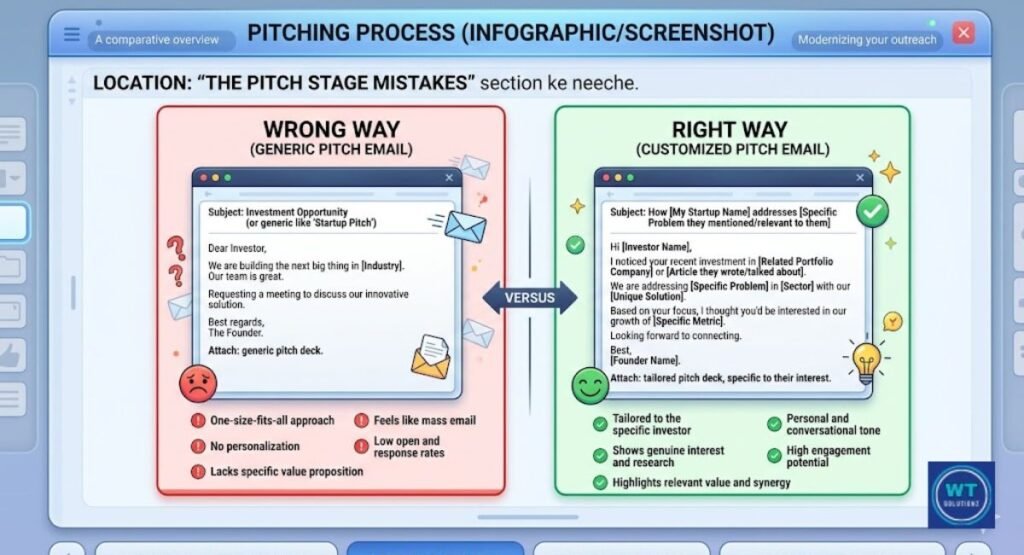
Before they ever type a word, the majority of people spoil their chances. Your outreach effort will either succeed or fail during the pitch stage.
Every day, editors receive dozens of pitches. Your item ends up in the garbage if it doesn’t stand out. These are the three most common pitch errors.
Send Out Mass Pitches
It seems effective to send the identical proposal to 100 bloggers at once. It isn’t. In two seconds, editors can identify a copy-paste pitch. It conveys to them your lack of interest in their website. It immediately lowers your acceptance rate.
A customized pitch that demonstrates that you have read their blog will always outperform a generic one. Always.
Building relationships begins with the first email you send. Bring up a particular post that you enjoyed. Refer to their audience.
Prove to them that you completed your homework by identifying what’s missing from their site through a content gap analysis. You outperform 90% of those who send cold pitches every day with only that one tiny step.
Send Out a Pitch Without Researching Guidelines
Every blog has guidelines. Everyone. Some desire 1,500 words. A few desire 2,500. Certain themes are only accepted by a few.
These are their editing standards and writing guidelines. If you disregard them, your pitch will be immediately removed.
Locate their “Write for Us” page before your pitch. Go over it word for word. Pay close attention to every rule.
This demonstrates professionalism and respect. Additionally, it demonstrates to editors that you follow directions, which is precisely the kind of contributor they are looking for.
Send a Pitch That Is Filled With Typos and Grammatical Errors
One thing is evident from a pitch full of typos: you’re careless. Editors say, “If their pitch looks like this, imagine what their article looks like.” The chance is lost before it starts. Your initial impression is where brand authority begins.
Run Grammarly on each pitch. Before sending it, read it aloud. Have a friend look it over.
Even though these are tiny actions, they have a significant impact. Clean writing demonstrates your professionalism, seriousness, and value to the editor.
Choosing the Wrong Guest Posting Service Can Harm Your Website
Not all guest post marketplaces and services are reliable. On Private Blog Networks (PBNs), some people sell links. Some people post your content on websites with no actual traffic.
Google severely penalizes these services for creating a spammy link profile. Selecting the incorrect one may result in manual actions (Google Penalty) that cause your rankings to plummet overnight.
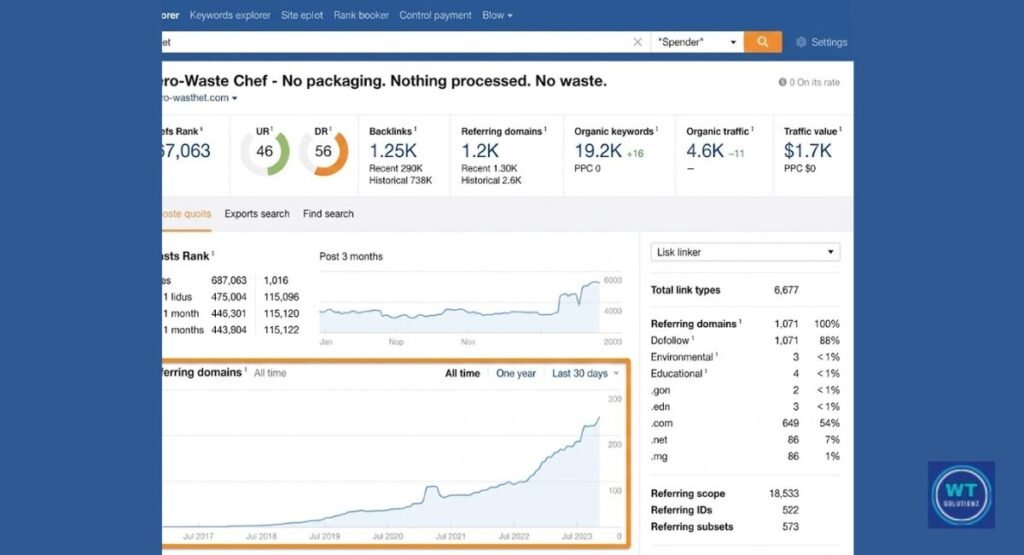
Verify any guest posting service before making a payment. Examine the websites they visit. Use tools like Ahrefs or SEMrush to perform a quick SEO audit and examine actual traffic figures. Request placements for samples.
A reputable agency that employs white hat SEO strategies won’t guarantee results right away and will be open about where they post material. When something seems too good to be true, it usually is.
Choosing Low-Quality Guest Post Sites
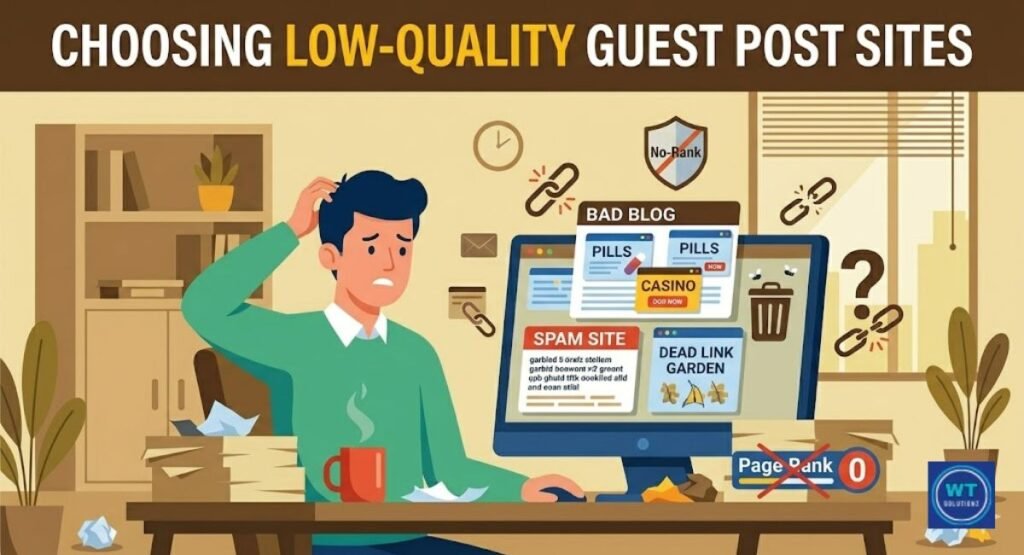
More than most people realize, niche relevancy is important. It may seem innocent to post on a website unrelated to your industry. It’s not.
Google considers your backlinks’ context. A link from a low-quality, irrelevant website adds very little value and may eventually lower your spammy link profile score.
Every time, quality triumphs over quantity. Ten links from arbitrary low-DA blogs are worth less than one link from a reliable, niche-relevant website.
Concentrate on creating fewer but more robust connections. You may create a backlink profile that genuinely makes a difference in this way.
How to Spot Low-Quality Sites
There are obvious warning indicators for poor-quality websites. thin content that lacks depth. pages that are overflowing with spam. No biographies or author names.
no presence on social media. No genuine feedback or interaction. All of them are warning signs that say “stay away.”
Before you pitch, check the spam score of any website using tools like Moz. Use SEMrush to check their domain’s presence in Google Search Console.
Their audience is also fake if they don’t receive any organic traffic, and your link won’t be of any use to you.
Evaluating Domain Authority and Relevance
Although Domain Authority (DA) is a valuable metric, it is not the whole picture. A website with a DA of 40 may have poorly relevant material for your subject.
That link won’t be very helpful. DA checks should always be paired with relevancy checks. Does this website discuss subjects that are similar to yours? Does their audience fit your target audience engagement objectives?
| Metric | Why It Matters | Recommended Tool |
| Domain Authority (DA) | Measures overall site strength | Moz, Ahrefs |
| Spam Score | Flags toxic or risky sites | Moz |
| Organic Traffic | Shows real audience size | SEMrush, Ahrefs |
| Niche Relevance | Ensures contextual fit | Manual review |
| Engagement Rate | Proves active readership | BuzzSumo |
| Backlink Profile | Checks link quality | Ahrefs, Majestic |
Not Sticking to the Topic or Writing Bad Content
One of the quickest ways to get rejected is to stray from the subject. Editors carefully present ideas to their readers. Your post falls short of their user experience (UX) criteria if it doesn’t live up to their expectations.
Readers depart. You are not invited back by editors. Everyone is in a lose-lose situation.
Rejecting bad content is not the only outcome. Occasionally, it is published and then disregarded. Not a share. Nothing to say. There is no traffic. Your ROI for content marketing suffers greatly as a result.
Prioritize the reader when writing. Always. Provide genuine depth, genuine value, and genuine responses. That’s what spreads and establishes your credibility as a true authority.
Provide Valuable Content, Not Self-Promotion
Advertisements do not appear in guest posts. Press releases are not what they are. Articles that sound like sales pitches are despised by editors. They are considerably more despised by readers. In just 10 seconds, readers will quit reading if every paragraph emphasizes how fantastic your product is.
Giving up your greatest knowledge for free is a sign of thought leadership. Provide readers with a helpful example. Give them a fresh lesson.
Assist them in resolving an actual issue. That’s how trust is developed. They visit your website after clicking on your link because of this. Being truly helpful is the source of social proof, not boasting about oneself.
Using Keyword-Heavy Author Bios
It’s not a keyword dump in your author bio. It appears spammy to stuff it with exact-match keywords and anchor text optimization attempts. In fact, it lets Google know that you’re attempting to manipulate ranks.
That’s not what you desire at all. Being natural, human, and unambiguous is what author bio optimization entails.
Don’t make your bio too long. No more than two or three sentences. Include one clear link back to your website along with a description of who you are and what you do.
Use a straightforward phrase or your brand name as a natural anchor text. That’s all. Don’t stuff it or overthink it. Simple always prevails.
Missing Basic SEO Elements
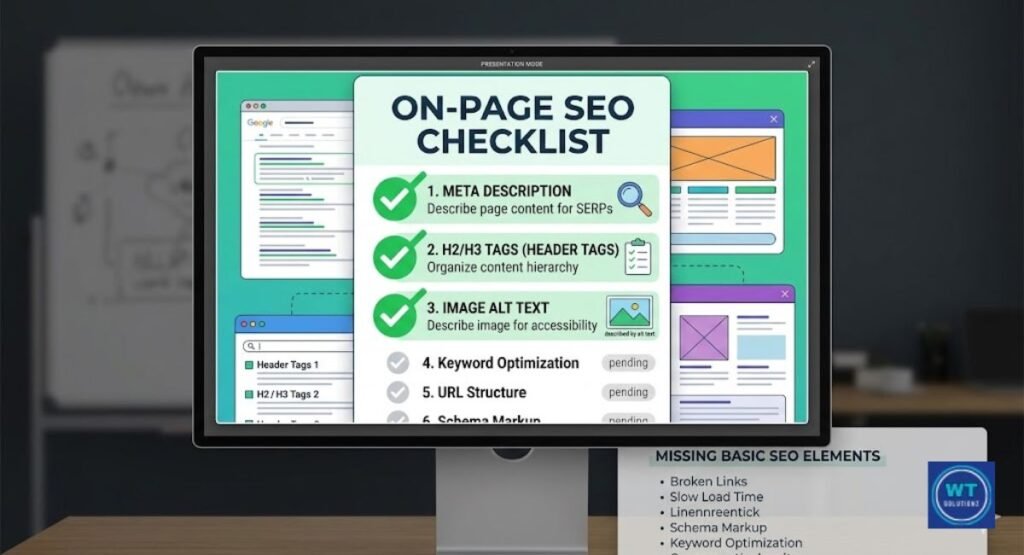
Excellent content is like a fantastic car without fuel if it lacks basic SEO. It’s not going anywhere. ignoring meta descriptions, omitting picture alt text, and missing headers.
These little mistakes pile up. For instance, understanding how meta descriptions impact SEO is crucial for your post’s visibility. Without these elements, it becomes difficult for Google to comprehend and rank your content
The correct H2 and H3 headers are required for each guest post. It requires a naturally occurring focus keyword. It requires logical connections both inside and outside.
These are not extras that are optional. Every post that genuinely ranks and brings referral traffic back to your website is built on them.
Optimizing Content for SEO Without Overstuffing Keywords
One of the most common and detrimental SEO errors is keyword stuffing. It doesn’t help to repeat your keyword in every sentence.
In fact, it renders your material unintelligible and results in search engine penalties. Google is intelligent. It now recognizes synonyms and context.
Make natural use of your focus keyword. Put it once or twice in the body, the title, one H2, and the introduction. Next, surround it with LSI keywords and similar terms.
This strategy adheres to white hat SEO tactics and ensures that your content reads as though it were written by a genuine person.
Incorporating Backlinks Strategically
Three haphazard links placed in inconvenient places are inferior to one well-placed contextual link in the article’s body.
The location of the link must make sense. The reader should gain something from it. Editors notice unnatural link placement instantly and will either remove it or reject the whole piece.
Before you pitch, be aware of link attribution (Dofollow/Nofollow). Only nofollow links are available on some websites. For traffic and brand exposure, that is acceptable, but it is less helpful for direct SEO value.
Before you spend time, make sure you know what you’re getting. If you have any questions concerning the editor’s linking policy, always ask them.
Why Duplicate Content Is a Problem
It may seem like a time-saver to submit the identical content to five separate sites. In fact, it’s a quick route to problems with duplicate content and Google fines.
Duplicate content is poorly ranked by Google. It selects one version and disregards the others. Even worse, it can detect tampering on your website and take active action against you (Google Penalty).
Each guest post needs to be unique. written from scratch. Only for that website. Indeed, it requires more time. However, it provides you with a genuine chance at ranking, safeguards your website, and honors the host blog.
Once you establish originality as a non-negotiable criterion for yourself, it’s easier to avoid link-building mistakes like duplicating content.
Forget to Respond to Comments
You are published. People ask questions and make comments. And you vanish. One of the most common errors in blogger outreach is this one.
The audience of the host blog will know you don’t care if you don’t reply to their comments. Additionally, it lets the editor know that you’re not a trustworthy contributor who should be invited back.
Engagement with your target audience doesn’t end when you press publish. Remember to return to each guest post within 24 to 48 hours of it being published.
Respond to each comment with sincerity. Express gratitude to others for their opinions. Respond to their inquiries. This raises the likelihood of receiving future invites for guest posts organically and fosters genuine connection development with a brand-new audience.
Not Setting Clear Goals for Guest Posting
Driving without a destination is similar to posting without a purpose. You won’t accomplish anything and will burn fuel. Each guest article must have a specific goal.
Are you attempting to develop backlinks of the highest caliber? Encourage traffic from referrals? Expand your list of emails? Develop a new market’s brand authority? Before you write a word, know your response.
Everything is shaped by your objectives. They decide which websites you should focus on. The subjects you propose are chosen by them. They direct your entire guest blogging approach. Without a goal, there is no way to gauge success.
Time is wasted when there is no objective. Each guest post campaign should have a single, well-defined goal, which should be monitored using real metrics tracking tools such as Ahrefs or Google Search Console.
Guest Posting Metrics Table
It is not optional to monitor your outcomes. It’s how you determine what is productive and what is a waste of time. For each guest post you publish, use this table to monitor important performance factors.
| Metric | What to Track | Best Tool |
| Referral Traffic | Visitors coming from your guest post | Google Analytics |
| Keyword Rankings | Did your target keywords move up? | SEMrush, Ahrefs |
| Backlinks Earned | Number and quality of links gained | Ahrefs, Majestic |
| Domain Authority Growth | DA increases over time | Moz |
| Engagement Rate | Comments, shares, time on page | BuzzSumo, GA4 |
| Conversion Rate | Did visitors take action on your site? | Google Analytics |
| Spam Score Change | Is your link profile staying clean? | Moz |
| Acceptance Rate | How many pitches are getting approved? | Manual tracking |
FAQs
What Are Guest Posting Mistakes to Avoid?
Mass pitching, disregarding writer requirements, and selecting low-quality sites are the worst guest posting blunders to avoid. These errors can result in search engine penalties and damage your high-quality backlinks. If you address them early on, your traffic will increase quickly.
Does Guest Posting Still Work?
Indeed, guest posting is still effective in 2025. It increases the authority of your brand, generates solid backlinks, and increases actual referral traffic to your website. All you have to do is do it correctly.
What Are Guest Posting Guidelines?
The rules a blog establishes for outside authors regarding themes, word counts, and linking conventions are known as writer guidelines. Before submitting a pitch, always locate and review them. Your acceptance rate is significantly increased if you adhere to them.
How to Do Guest Posting Step by Step?
Locate websites that are related to your expertise, review their policies, and submit a customized pitch. Create unique, insightful content with natural links and clear anchor text optimization. Next, use Google Search Console to monitor your results and respond to each remark.
Conclusion: Building a Long-Term Guest Blogging Strategy
This is the main point. Posting as a guest is effective. But only if you approach it as a serious tactic. All of the errors discussed in this article are preventable.
Pitching in bulk, disregarding rules, selecting unreliable websites, producing weak content, cramming keywords, replicating articles, and ghosting comment areas. You don’t have to experience any of these.
Focus on quality, relevance, and genuine value while developing your guest blogging plan. Select websites that fit your niche. Create content that will actually benefit readers. Keep an honest record of your outcomes. Address your audience.
What isn’t working should be fixed. Real results from guest posting don’t materialize right away, so be persistent and patient. Post after post, link by connection, and relationship by relationship, they gradually accumulate.
The most popular blogs and brands are not the ones that benefit from guest posting. The best posts are made by them. So go more slowly. Make an effort.
Observe the guidelines in this article. And observe the proper growth of your traffic.