It is the methodical process of figuring out what subjects and keywords your target audience is looking for, but your website doesn’t currently have.
In order to establish ultimate topical authority in 2026, a successful analysis entails assessing your current material, investigating competitive gaps, and optimizing for AI Overviews.
Traffic doesn’t vary even though you publish once a week. That irritates me.
After overseeing multiple WordPress websites at WebTechSolutionz, I’ve come to the straightforward conclusion that what you write is more important than how much you write.
A content gap analysis identifies the specific topics that your audience is searching for but cannot find on your website. It is your route plan for SEO.
Google notices when you fill in those gaps with high-quality content. Rankings increase. There is an upsurge in traffic. Furthermore, when AI search revolutionizes everything in 2026, this process will no longer be optional.
This is how real marketers are successful. Here’s how to do an exact content gap analysis.
How to Perform a Content Gap Analysis: A Beginner’s Guide to 2026 SEO
Topics, problems, and phrases that your audience searches for but your website doesn’t cover are identified via a content gap analysis. Think of it as a map.
You take your audience’s needs into account. You look over your belongings. Then you notice what’s missing. Those missing pieces are your gaps.
Google wants to send consumers to pages that fully address their questions. If your competitor covers a topic better than you, they receive the click.
They receive the ranking. You don’t. Furthermore, responses from Google’s most reliable pages will be extracted by AI Overviews by 2026. If there are gaps in your content, you become invisible in more and more searches.
Topical authority is crucial these days. Unfinished content cannot be used in its construction.
Content Gap vs. Keyword Gap: Understanding the Difference
These are often confused with one another. They are not interchangeable. A keyword gap research looks at specific search terms where competitors outperform you.
It is advantageous. It is limited, though. Content gap research goes much deeper. It looks at complete topics, search intent, content quality, and whether your sites actually help readers at every stage.
Here’s a simple method for doing it.
A keyword gap can look like this: “They rank for this phrase, and you don’t.” “They answer this whole question better than you, and here’s why.” is a fixed term based on a content gap.
The other fixes a strategy. Both are significant, but content gap analysis is what drives long-term ranking growth.
| Feature | Keyword Gap Analysis | Content Gap Analysis |
| Focus | Missing search terms | Missing topics and intent |
| Depth | Surface level | Deep and strategic |
| Output | Keyword list | Content roadmap |
| Tools | Ahrefs, Semrush | Tools + manual research |
| Goal | Rank for more terms | Build topical authority |
Step 1: Set SMART Goals and Identify Your Audience Persona
Make sure you know what you want to do before opening any tools. If a content gap analysis is not directed, it just gives you a random list of topics. Not advantageous.
You may maintain focus on your analysis by using SMART targets. The acronym SMART stands for Specific, Measurable, Achievable, Relevant, and Timebound. Don’t say anything along the lines of “I want more traffic.
For example: I want 25% more organic traffic in 90 days by targeting informational gaps in my niche.” That is a valid goal.
Your audience is just as vital. Determine who your target market is. Based on their problems, search trends, and purchasing habits, you may decide which gaps to address.
Make a simple persona. Keep track of what your reader does for work, what gets them stuck, and what they type into Google when they’re frustrated at 11 p.m.
That list? You need to fill in these gaps in your text.
Quick Audience Persona Template:
| Field | Your Answer |
| Who are they? | (e.g., small business owner, 35-50, USA) |
| Their biggest problem | (e.g., low website traffic despite publishing content) |
| What they search for | (e.g., “Why isn’t my blog getting traffic?”) |
| What they want | (e.g., a clear step-by-step fix they can do themselves) |
| What stage are they in | (Awareness / Consideration / Decision) |
Step 2: Map Your Content to the Buyer’s Journey (TOFU, MOFU, BOFU)
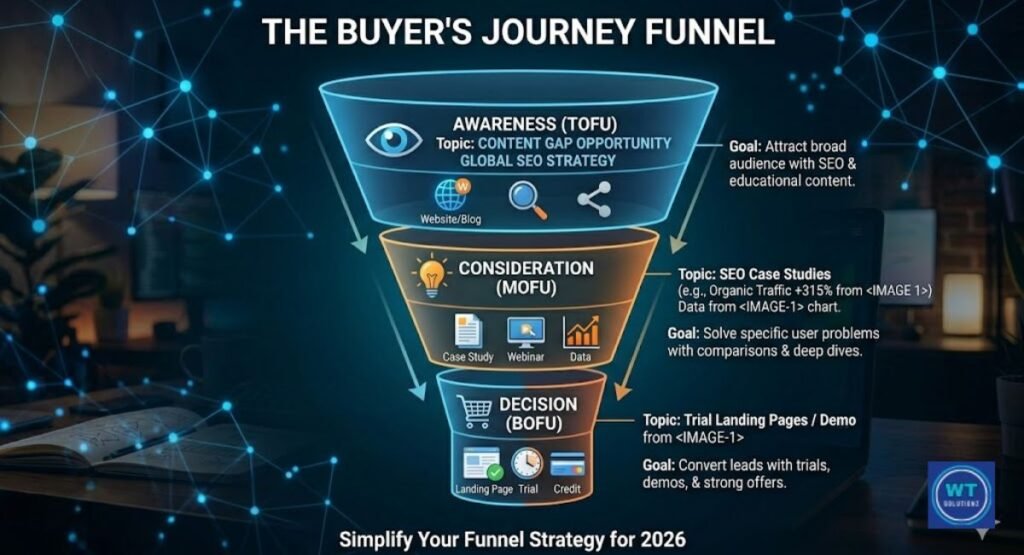
Your content funnel consists of three steps. Each of them has a distinct gap. Your entire content marketing strategy will change if you execute this well.
At the top, people are still learning (TOFU). They search for broad questions like “what is content marketing” or “why isn’t my site getting traffic.”
Guidelines, tutorials, and blog posts fill these gaps. In the middle, people compare options (MOFU). They search for “content audit checklist” or “best SEO tools for small business.
“They are ready to buy at the bottom (BOFU). They search for “hire SEO agency” or “Ahrefs vs Semrush.”
A fundamental mistake is that most websites totally disregard TOFU.
If you have built trust at the top and middle, people will already know you when they are ready to buy.
Content Types by Funnel Stage:
| Funnel Stage | Search Intent | Content Type | Example Topic |
| TOFU | Informational | Blog posts, guides, videos | “What is a content audit?” |
| MOFU | Navigational | Comparisons, case studies | “Ahrefs vs Semrush for content gaps” |
| BOFU | Transactional | Landing pages, reviews | “Best content gap analysis service” |
Step 3: Audit Your Existing Content for Freshness Gaps

Most people skip this step. Don’t do that. Before taking on new subjects, consider what you already know. Examining every page on your website to see if it is still accurate is known as a content audit.
Is it still useful? Does it still meet the demands of readers today? You can find that half of your website’s traffic problems are caused by outdated, thin, or outdated pages.
There’s a pause in the freshness. Your page was great two years ago. But the facts and statistics are out of date, and a competitor provides much better coverage of the same topic.
The answer is simple. Make changes to it. Improve the writing, incorporate new information, and improve the organization. Most updated pages return to better ranks within 60 days.
Pay special attention to your product pages during the auditing process.
If you have an online store, check out our tutorial on WooCommerce Care Plans 2026 to ensure that your website continues to function flawlessly as you add more content.
Start Google Search Console first. Look for pages that people aren’t clicking on anymore. Create a basic spreadsheet.
Provide the most recent update date, visitor volume, and recommended action for each URL. That’s where you should begin.
Content Audit Action Codes:
| Page Status | What to Do |
| Low traffic, outdated info | Refresh and update |
| Thin content, under 500 words | Expand or consolidate |
| Duplicate topics | Merge into one stronger page |
| Strong traffic, slightly old | Add new stats and examples |
| Zero traffic, off-topic | Remove or redirect |
Step 4: Analyze Competitor Content to Pinpoint Opportunities
Your rivals are essentially giving you a road map. You can fill in for any issue they rate for which you don’t. Furthermore, it’s not conjecture.
These subjects have demonstrated their ability to increase traffic in the past. Instead of forecasting the market, you are reading it.
Select three to five rivals. Instead of Amazon or Forbes, pick websites that are comparable to yours in terms of size and substance.
Use the Keyword Gap tool after entering their domains into Ahrefs or Semrush. They rank in the top ten for every phrase you don’t cover at all. Don’t merely copy their subjects, though.
Continue. Examine the pages with the highest rankings. Take a look at the title tags. Look over the post. What is the duration of it? What queries does it address?
Does it make use of pictures or tables?” Can I cover this better, with fresher data, clearer writing, and stronger examples?” is the next question you should ask yourself. If so, add it to your list.
Examine backlinks as well. The significant number of backlinks on a rival page indicates that the subject has genuine authority potential. Seek it out.
Expert advice: Use AlsoAsked.com to discover the precise queries that actual people have concerning the most popular subjects of your rival.
That’s your gap list, given to you at no cost.
Step 5: Check for Gaps in AI Search and Google’s AI Overviews
The majority of 2026 SEO advice disregards this. Big mistake. Most search results now show Google’s AI Overviews at the top.
They use responses from pages that Google deems reliable and well-structured.
You have a widening gap and are becoming less visible every day if your material isn’t appearing there.
Generative Engine Optimization (GEO) is the term for this. It entails writing for both AI-powered search and conventional rankings.
Your material must promptly and directly address questions in order to close this gap. The E-E-A-T requirements, real experience, real knowledge, real authority, and real trust must all be met.
When possible, give first-person examples. Cite reliable sources. At the beginning of each part, use clear headings and brief responses.
Give a thorough description of your subject. When you write, keep humanity in mind. Then consider this: would an AI choose a passage from my website to respond to this question?
If so, you’re headed in the correct direction.
AI Overview Readiness Checklist:
| Check | Status |
| Does your page directly answer the main question? | Yes |
| Is the answer near the top of the page? | Yes |
| Do you cite real data or sources? | Yes |
| Do you follow E-E-A-T guidelines? | Yes |
| Is your page structured with clear H2s and H3s? | Yes |
| Do you cover related subtopics on the same page? | Yes |
Analyzing “People Also Ask” and SERP Features
Mining PAA Boxes for Real Content Gaps
The People Also Ask section of Google is great. Each of those questions is something that actual people look up.
Each of these could also be a hole in your website. Go find your main theme now. Examine the PAA box.
To access some of the questions, click on them. As you click, observe how new ones emerge.
That’s Google providing you with current information on your audience’s interests.
Consider each PAA question as a possible H2 or H3 in your writing.
You have a chance to get that PAA place if your response is superior to everyone else’s on the page. Real estate SERPs are free. No additional fees.
Additionally, look beyond PAA. Short, direct responses are rewarded in featured excerpts.
Step-by-step instructions with lucid graphics are preferred in video carousels. Strong alt text for photos is promoted using image packs. With the appropriate content format, you may fill in every gap in the SERP.
Additionally, there is frequently minimal competition for PAA keywords. A well-written 300-word response can immediately win.
Prioritizing Your Findings: High Volume vs. High Intent
Your list of gaps is now complete. Fantastic. However, you can’t write everything at once.
Additionally, it is inefficient to spend the same amount of time on each gap. At this point, most people are halted. Avoid doing that.
Focusing solely on search volume is the biggest error. When you find out that large corporations possess a keyword with 50,000 monthly searches and that their objectives are different from your own, it could seem fantastic.
Change in intent. A topic that receives 500 monthly searches from prospective clients or staff members is frequently ten times more beneficial than a viral topic that generates no revenue.
Your gaps should be evaluated based on four factors: search volume, intent match, level of competition, and creation time. Choose the top five.
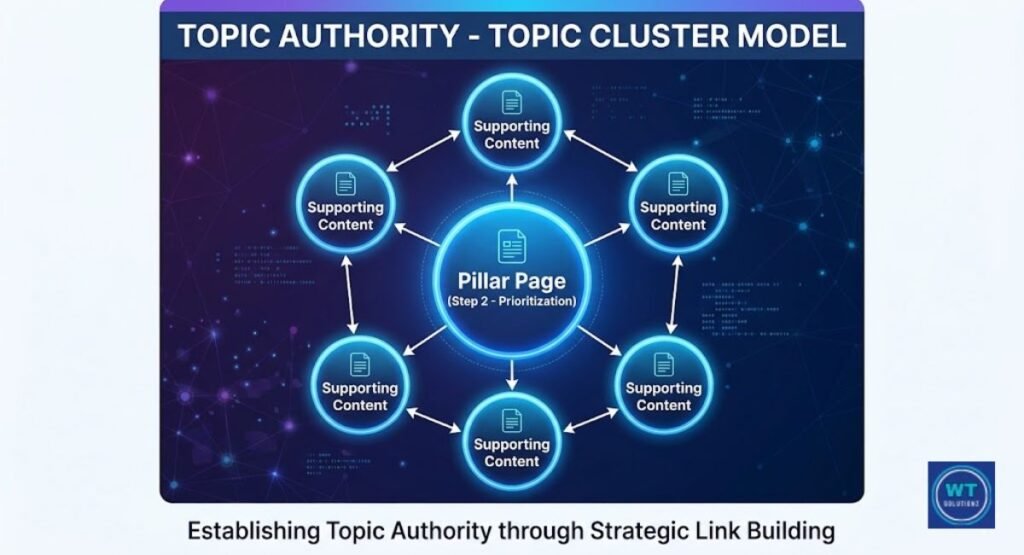
Create Pillar Pages for your primary subjects. Use inventive internal connections to connect your supporting content to them.
This is how Google is informed about Topic Authority and how Topic Clusters are constructed. Don’t hurry. Twenty scattered pieces are always destroyed by five focused ones.
Gap Prioritization Scoring Matrix:
| Topic / Gap | Search Volume | Intent Match | Competition | Effort | Priority Score |
| Content audit checklist | Medium | High | Medium | Low | High |
| What is a content gap | High | Medium | High | Medium | Medium |
| Content gap tools free | Medium | High | Low | Low | Very High |
| Content gap analysis template | Low | Very High | Low | Low | Very High |
Measuring Your Success: KPIs to Track After Implementation
The first step is to complete the work. The second stage is to determine whether it was successful. Step two is not taken by most people.
That is an issue. You won’t know what to continue and what to discontinue if you don’t keep track.
Keep an eye on these KPIs: keyword ranking positions, average time on site, organic visitors per page, search click-through rate, and conversions from new material, such as purchases or form fills.
For click metrics and ranking, use Google Search Console. For traffic and behavior, use GA4. Before assessing new content, give it 60 to 90 days.
It takes time to rank. However, they compound quickly once they start moving.
Every quarter, review your content gap analysis. Trends in searches change. There are now new rivals.
Google modifies its algorithm. This is an ongoing effort. However, if you develop the habit, your SEO improves annually.
Information regarding real-world problem-solving is typically helpful. It’s not a passing trend. That rating is simply excellent.
KPI Tracking Schedule:
| KPI | Tool | Check Frequency |
| Organic traffic per page | GA4 | Monthly |
| Keyword ranking positions | Google Search Console / Ahrefs | Weekly |
| Click-through rate | Google Search Console | Monthly |
| Time on page | GA4 | Monthly |
| Conversions from content | GA4 | Monthly |
| Featured snippet wins | Manual SERP check | Monthly |
Read Also:
Toxic Backlinks
How to Submit an XML Sitemap to GSC
Why are internal links important for SEO
How to Identify Conversion Killers Through an SEO Audit
What Is the Difference B/W SEO Analysis and an SEO Audit
The Bottom Line
One of the best things you can do for organic traffic in 2026 is to conduct a content gap evaluation.
It eliminates any uncertainty. It provides detailed information about your target audience’s preferences and your website’s shortcomings.
Google will reward you if you fill in those gaps with quality, helpful, and authentic content.
Begin modestly. Choose a step from this instruction and complete it right now.
Conduct a brief content audit. Look for your primary topic in the People Also Ask box. Find out which terms a rival ranks for that you don’t by using a free tool.
It’s not necessary to do everything at once. All you need to do is begin.
What is the largest content gap on your website currently?
Post it in the space provided for comments. Let’s discuss it.