Have you ever clicked on a link simply because it made sense? Most people don’t realize how important these so-called anchor text phrases are. Every connection you make sends a signal to Google.
The words in the link provide search engines with additional information about the content of the destination website. If you optimize your anchor text correctly, your pages will rank higher. Google will gently discourage you if you make a mistake.
Understanding the different types of anchor text is one of the best things you can do for your link-building strategy. This workshop covers all you need to know to build a more dependable and organized backlink profile in 2026.
Your search engine rankings are impacted. Let’s begin now, but first, ensure your profile is free from toxic backlinks.
What is Anchor Text and Why is it Important for SEO?
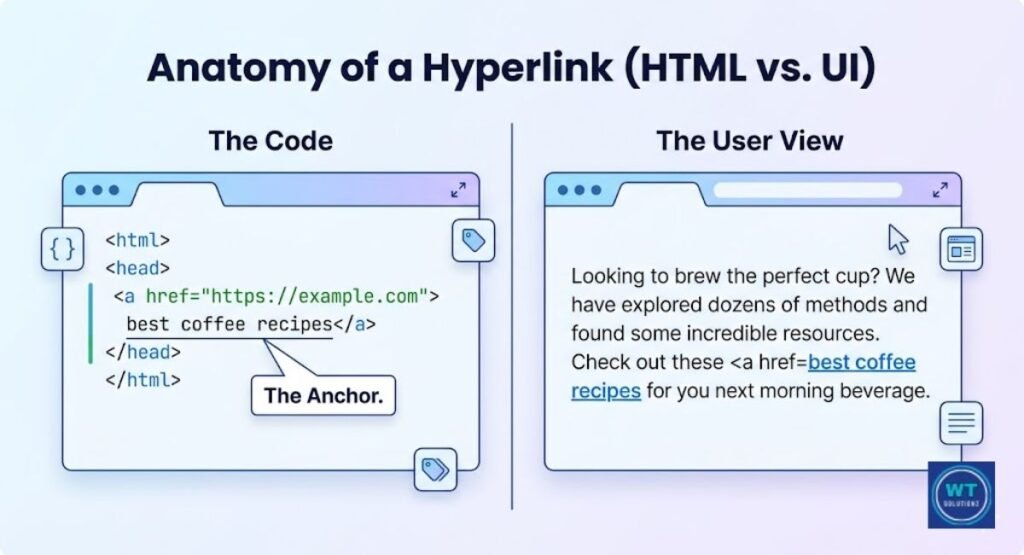
Anchor text is the visible, clickable text that appears inside a hyperlink. A link that says, “learn SEO basics,” has only three terms in its anchor text.
They are hidden inside an HTML tag that looks like this: learn SEO basics. Both consumers and search engines can learn more about the connected website from the terms you choose for that link.
Anchor text is one of Google’s main markers for search engine results. For instance, Google will recognize that your page is about coffee recipes if hundreds of websites link to it using the term “best coffee recipes.”
As a result, it becomes more relevant. This encourages self-assurance. Your page appears higher in search results as a result. Anchor text optimization will be required by 2026. It is a crucial part of any plan for smart links.
The Role of Anchor Text in an SEO Strategy
Anchor text is the foundation of your link-building strategy. Every time someone links to your website, the words they use have the potential to help or hurt you.
When you have a range of anchor types, Google can determine that your links are legitimate and well-deserved. A weak, monotonous combination immediately sparks suspicion and seems manipulative.
Your anchor text also affects the user experience (UX). Readers decide whether or not to click based on these terms. Clear labels promote clicks and explain why internal links are important for SEO by guiding users through your site.
High-quality anchor text boosts traffic and enhances SEO. That kind of dual gain is what every content writer seeks from their link-building strategy.
10 Common Types of Anchor Text You Need to Know
Before you create a single link, you need to be aware of your toolkit. Ten main types of anchor text are used by all SEO experts.
Each of these sends different signals to Google. All of them are suitable in different situations. The table below gives you a quick summary of each area before we get into more detail.
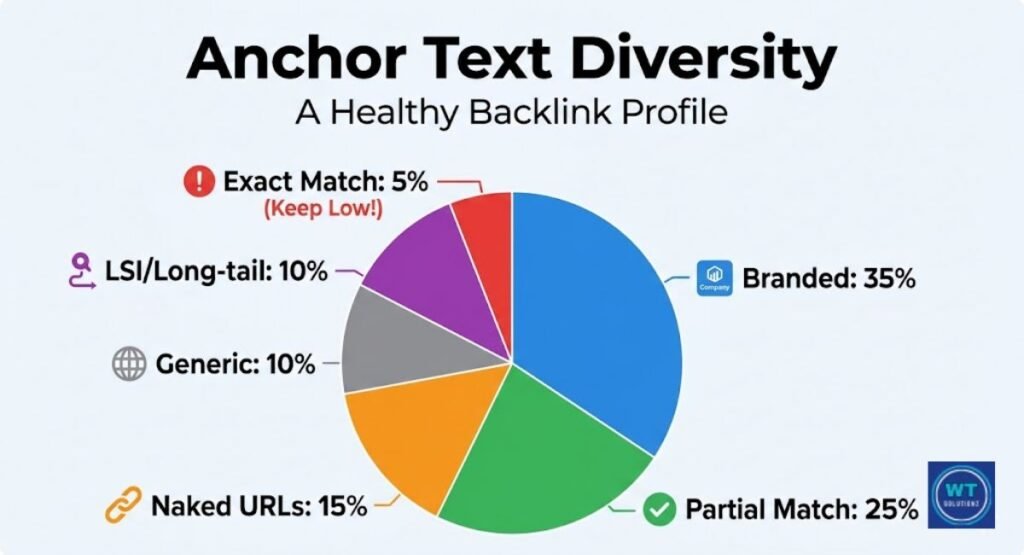
Diversity in anchor texts is more than just a clever idea. It’s a rule. Google’s algorithm is smart enough in 2026 to spot profiles that rely too much on one kind.
A natural and healthy backlink profile gives the impression that actual people are interacting with you in sincere ways. Real individuals also utilize a type of link text. This is the full picture:
| # | Type | Example | Risk Level |
| 1 | Exact Match | “10 types of anchor text” | High if overused |
| 2 | Partial Match | “learn about anchor text types” | Low to Medium |
| 3 | Branded | “Ahrefs” or “Moz” | Very Low |
| 4 | Naked URL | “https://yourblog.com/seo“ | Very Low |
| 5 | Generic | “click here”, “read more” | No SEO Value |
| 6 | LSI Keywords | “hyperlink text variations” | Very Low |
| 7 | Brand + Keyword | “Ahrefs link building tool” | Low |
| 8 | Image Anchor (Alt Text) | Alt=”anchor text types chart” | Low |
| 9 | Long-tail | “best anchor text types for SEO 2026” | Very Low |
| 10 | Latent Semantic | “Learn about anchor text types.” | Very Low |
1. Exact Match Anchor Text
Your target term is used exactly as it is in the link text in the exact match anchor text. It’s a great fit if someone links to your page that particularly targets “10 types of anchor text” using those terms.
It gives Google a clear and potent suggestion about what’s on your page.
This is the catch, though. It appears odd when there is an excess of it. Real individuals don’t always use your identical term when they link. The 2012 Google Penguin update targeted websites that misused exact match anchors for gaming rankings.
Aim to keep the percentage of exact match anchors in your link profile below 10%. Twenty forced exact match links are not worth as much as one powerful, earned one.
2. Partial Match Anchor Text
Your keyword is included in the partial match anchor text, and it is surrounded by additional terms. Rather than “anchor text types,” you may see “learn more about anchor text types for your site.”
Your keyword is still present. However, it sounds far more like something a real person would write.
There is a sweet spot for this type. Without the over-optimized appearance that results in penalties, it provides Google with helpful search engine context.
To avoid penalties, you must also understand how dofollow vs nofollow links affect your link juice distribution.
Partial match anchors should make up between 20 and 30 percent of your backlink profile, according to the majority of SEO specialists. They have a human feeling. They are highly ranked. Additionally, Google’s algorithm awards them for their contextual relevance.
3. Branded Anchor Text
The link in branded anchor text is the name of your business or website. Without using any keywords, consider “HubSpot,” “Neil Patel,” or “Backlinko.” No deception. Just a hyperlink with your brand name inside.
Because it conveys authority and trust, Google adores this kind. Authentic brands are referred to by name. The internet operates in this manner.
Thirty to forty percent of your link profile should consist of branded anchors. They are your best option if you want to increase domain authority without having to worry about fines. Develop your brand, and the links will come to you organically.
4. Naked URLs
The raw web address is used as the link text in a naked URL anchor. similar to this: https://yourblog.com/seo-tips.
This is frequently observed in press announcements, forum postings, citations, and social media. It is transparent, uncluttered, and impossible to overoptimize.
Link variety is naturally enhanced by naked URLs. They resemble something a person would include in a news story or blog comment when citing a source.
Although they don’t have significant keyword power, they do convey genuineness. To maintain the natural appearance of your profile, use them in directories, citations, and social media accounts.
5. Generic Anchor Text
Phrases that are generic anchors include “click here,” “read more,” “this page,” and “visit site.” They provide Google with virtually no keyword indications. However, don’t dismiss them entirely.
When utilized within buttons, calls to action, and navigation menus, they continue to contribute to on-page SEO.
The problem is that too many generic anchors result in lost opportunities. Sending a relevance signal is possible with every connection.
For UX purposes, use generic anchors, but counterbalance them with more descriptive types. Consider generic anchors as your link strategy’s background noise. beneficial in tiny dosages. useless in large quantities.
6. LSI Keywords Anchor Text
Latent Semantic Indexing is referred to as LSI. Words and phrases that are closely associated with your primary keyword, put simply.
LSI anchors for your target keyword, “anchor text types,” could be “hyperlink text labels,” “link text variations,” or “clickable text in SEO.” Google recognizes these as related ideas.
This type of diversity is crucial to semantic SEO. By using LSI keyword anchors, you may avoid using the same keyword repeatedly and provide Google with a more comprehensive picture of your content.
Strong LSI choices can be found using tools like LSIGraph or even Google’s “related searches” area at the bottom of search results. Make free use of them. They work quite well for balancing keyword density and are low-risk.
7. Brand + Keyword Anchor Text
This kind combines a pertinent term with your brand name. An example might be “Ahrefs keyword research tool” or “Moz link building guide.”
It’s a hybrid strategy that offers two advantages in one connection. In addition to increasing brand awareness, it simultaneously transmits a topical keyword signal.
This kind of anchor is particularly useful for editorial mentions and guest posts. This structure is perfect when you start guest posting in 2026 to build authority naturally.
In authentic content, it feels genuine and provides Google with context for search engines as well as brand trust. Try to use this structure for 10 to 15 percent of your link profile.
It’s especially effective when attempting to rank for competitive keywords and establish the authority of your brand in a particular niche.
8. Image Anchor Text (Alt Text)
Google uses the alt text for photos as the anchor when a linked image is text-free. Thus, the alt attribute becomes the anchor text that Google views if you have a chart called “anchor text distribution” that links to your SEO guide.
Although most people totally forget about it, it functions precisely like standard text anchors.
This is a huge lost chance. Every connected image on your website should include alt text that is related to your keywords. Don’t exceed 125 characters. Describe it.
Alt=”10 types of anchor text chart 2026″ is a wonderful example. Because screen readers rely on alt text to describe images to visually challenged people, this also improves accessibility.
beneficial to SEO. beneficial to humans. win-win.
9. Long-Tail Anchor Text
A complete sentence or phrase serves as the link in long-tail anchor text. For example, “best types of anchor text for SEO in 2026” instead of just “anchor text types.”
These anchors are extremely low-risk and exceedingly specific. They appear entirely natural, so Google’s algorithms don’t have any problems with them.
Additionally, voice search and conversational queries, which are rapidly expanding in 2026, are tapped into by long-tail anchors. When someone asks their phone, “What are the best types of anchor text for SEO?” your long-tail anchor signals precisely correspond to the search intent.
Although most people don’t utilize them, these anchors have significant ranking power and virtually no drawbacks.
10. Latent Semantic Anchor Text
Synonyms and phrases that are conceptually connected to your primary keyword are known as latent semantic anchors. Latent semantic anchors for “anchor text,” for example, might be “hyperlink labels,” “link descriptors,” or “text-based links.”
These are recognized as equivalent signals by Google’s natural language processing engine.
Advanced SEO practitioners use this kind as a secret weapon. What specialists refer to as topical authority is created by using latent semantic anchors.
It informs Google that you have covered a topic thoroughly and from several perspectives. This level of depth can be rewarded by Google’s AI around 2026. Therefore, avoid just repeating your keyword in many anchor strings. Put it another way.
Reword it. Make use of semantic SEO.
Natural Anchor Text vs Unnatural Anchor Text
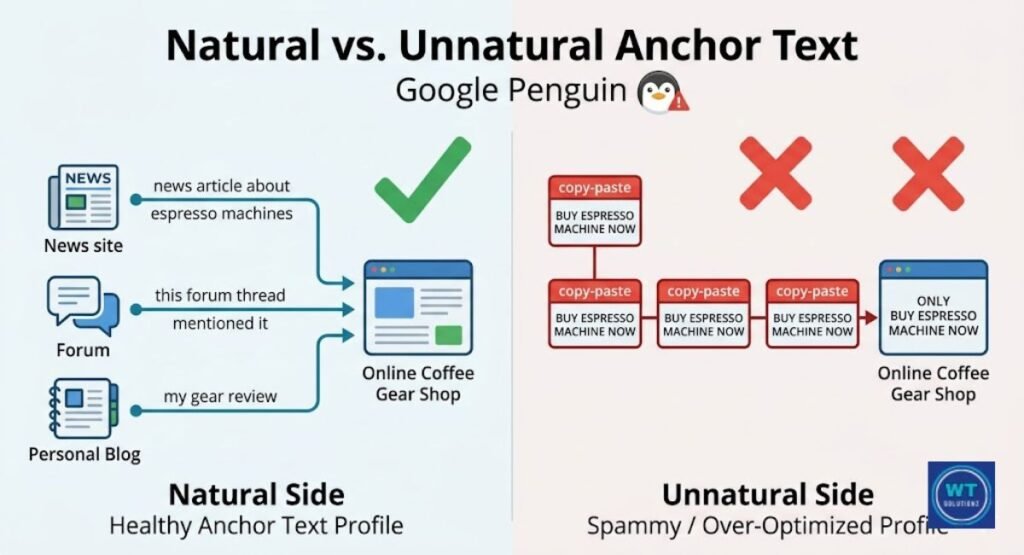
You can prevent a significant Google penalty for your website by knowing the difference between natural and unnatural anchor text. Natural anchor text appears to have been written by a real person who linked to your material in their own words after finding it helpful.
Unnatural anchor text gives the impression that each link was purposefully created to contain the same term repeatedly.
The purpose of the Google Penguin update was to identify artificial link profiles. Websites that used exact match anchors in their external links witnessed a sudden decline in their rankings.
The following table illustrates the precise differences between the two:
| Natural Anchor Text | Unnatural Anchor Text |
| Mix of all 10 types | Only exact match anchors |
| Earned from real editorial content | Paid links or spammy link practices |
| Varied wording across links | Identical anchor text repeated hundreds of times |
| Relevant to surrounding content | Irrelevant to the page it links to |
| Looks different across every source | Copy-pasted across link networks |
The key is to construct links as though the anchor text is being chosen by a genuine editor at a real magazine. Because a genuine connection profile looks just like that.
6 Anchor Text Best Practices for SEO
There are a few guidelines that all SEOs should adhere to when it comes to smart anchor text optimization. These are not conjectures. Thousands of link audits and algorithm changes have taught us these lessons.
The following six suggested practices include everything from designing anchors that generate clicks to avoiding penalties.
In addition to the three H3 sections listed below, keep in mind these three additional guidelines: diversify your anchor types throughout all of your link-building campaigns; audit your anchor profile every three to six months; and always match your anchor text to the content on the linked page.
These practices maintain the cleanliness and credibility of your backlink profile while safeguarding your rankings.
Don’t Over-Optimize (Avoid Keyword Stuffing)
One of the quickest ways to receive an over-optimization penalty from Google is by over-optimizing. Google does not consider your backlinks to be of high quality if 40% of them utilize the same anchor text.
It considers it to be manipulation. And it responds appropriately by lowering your rankings.
Your exact match anchors should make up no more than 10% of your entire link profile. Distribute your anchor types among the ten categories. Link diversity can be compared to insurance.
Your website is more protected from any future algorithm changes if your anchor profile is more varied. Twenty dubious links are always outperformed by one flawless one.
Keep Anchor Text Concise and Natural
The ideal anchor text is succinct, understandable, and explains exactly what the reader will discover after clicking. In most situations, try to keep it to one to five words.
Anything longer begins to feel awkward or crammed. Additionally, Google uses click-through rate (CTR) signals to detect problematic reading.
Because readers are more likely to trust descriptive link labels, they perform better than ambiguous ones. “Clicks on “anchor text guide” are higher than those on “this useful resource right here.”
A significant portion of online traffic increasingly originates from mobile devices, where short anchors appear cleaner. Hold it tight. Be truthful. The rule is that.
Ensure the Surrounding Text is Relevant
Google reads more than just your anchor text. It reads the entire text that surrounds it. We refer to this idea as co-citation.
The surrounding content validates the contextual relevance of a link to an SEO guide from a paragraph about trends in digital marketing. This increases the strength of the bond.
Content that is pertinent to your link serves as further proof. This connection makes sense here; it says Google. It has a place. Don’t merely insert a link into haphazard content and cross your fingers. Put it in a paragraph that makes sense for the subject.
The signal includes the surrounding text. Both your internal and external links will function better if you handle them that way.
How to Audit Your Anchor Text Profile
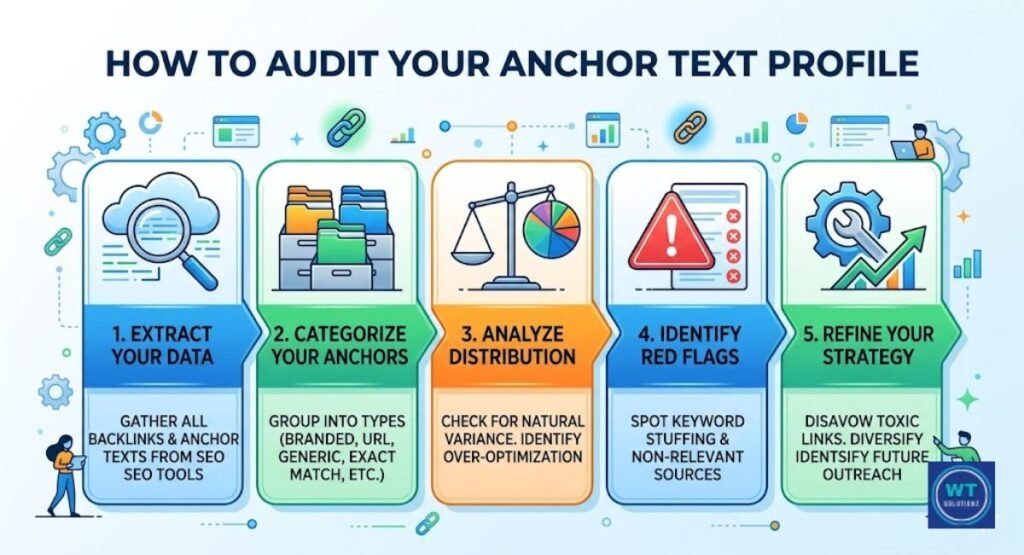
It’s easy to audit your anchor text. However, the majority of individuals ignore it and then question why their ranks stagnate or decline.
Use this variety to strengthen your silo internal linking and dominate your niche.
A thorough audit reveals the precise kinds of anchors that comprise your backlink profile, the locations of any imbalances, and the next steps to take. Here are five easy steps to follow.
Step 1: Pull your backlink data. To export your whole list of backlinks together with their anchor text, use Ahrefs, SEMrush, or Google Search Console. These tools display all of the links that lead to your website, along with the precise words that were utilized.
Step 2: Sort Your Anchors. Each anchor should be sorted into one of the ten categories of anchor text. Make use of a spreadsheet. Sort by type using color. This provides you with a visual representation of the current state of your profile.
Step 3: Verify your ratios. An anchor profile in good health resembles this:
| Anchor Type | Healthy Range |
| Branded | 30 to 40% |
| Partial Match | 20 to 30% |
| Naked URL | 10 to 15% |
| Exact Match | Under 10% |
| Generic | 10 to 15% |
| LSI and Long-tail | Remainder |
Step 4: Look for warning signs. It’s a red flag if one anchor type predominates in your profile. You run the danger of incurring an over-optimization penalty if you have too many exact-match anchors. You should add anchors from irrelevant or spammy websites to your disavow list.
Step 5: Act. Use underrepresented anchor kinds to create new links. Make an effort to get branded mentions. Use Google Search Console to reject harmful links. Going forward, update your internal linking to reflect a more intelligent anchor strategy.
Anchor Text Strategy: Diversify Your Anchor Text Styles
One fundamental tenet of a successful anchor text approach in 2026 is that your profile shouldn’t be dominated by a single anchor type.
Consider your backlink profile as a portfolio of investments. One poor day can wipe you out if you invest all of your money in a single stock. You can maintain stability even when one area suffers if you distribute it over several assets.
Anchor text follows the same reasoning. All ten sorts of links should be organically distributed by your link-building approach. For citations and directory entries, use branded anchors. In editorial and guest contributions, make use of partial match and LSI anchors.
Post naked URLs on social media and in forum conversations. Allow generic anchors to reside in your buttons and navigation. When you combine all of this, your profile seems just like Google prefers: genuine, earned, organic links from actual people.
“The most effective connection profiles appear to have been completely unplanned. In 2026, every SEO expert should approach every link-building campaign with this philosophy.”
This is a comprehensive checklist to have on hand:
| Action | Done? |
| Mix exact match, partial match, and branded anchors | Yes |
| Use naked URLs and generic anchors for natural diversity | Yes |
| Write relevant content around every link | Yes |
| Audit your anchor profile every 3 to 6 months | In progress |
| Never over-optimize any single anchor type | Yes |
| Match the anchor text to the linked page’s topic | Yes |
| Use alt text for images on all linked images | No |
| Avoid spammy link practices at all costs | Yes |
FAQs
How many types of anchor text are there?
The majority of SEO specialists identify ten primary categories of anchor text. These include everything from naked URLs and picture alt text to exact match and branding, anchors. In your overall link-building strategy, each category has a distinct function.
What are the different types of anchor text?
Exact match, partial match, branded, naked URL, generic, LSI keywords, brand plus keyword, image anchor text, long-tail, and latent semantic are the ten categories. When combined, they cover every possible label for a link in search engine optimization (SEO).
What is the best anchor text?
There isn’t just one ideal kind. For search engine rankings, a balanced combination of branded, partial match, and LSI anchors usually performs well. A varied, organic-looking profile is always the aim.
How do I know what type of anchor to use?
Align the linking context with the anchor type. In directories and citations, use branded anchors. In editorial content, make use of partial match anchors. For buttons and navigation, use generic anchors.
What is the best practice of anchor text?
It should be organic, succinct, and pertinent to the page it links to. Regularly review your backlink profile and make sure that no single anchor type is overused in your link-building efforts.
What is the most popular type of anchor?
In natural link profiles, branded anchor text is most prevalent. It conveys authority and trust to Google. Particularly in internal linking and navigation, generic anchors such as “click here” are the second most popular.
How to choose an anchor text?
Pose three questions to yourself. Is the referenced page described by this anchor? Does it make sense in the context of the sentence? Does it align with the search intent of a potential clicker? You have a decent anchor if all three are true.
Conclusion: The Anchor of Your Link Strategy
You now understand how each of the ten different kinds of anchor text fits into a clever SEO strategy.
In the end, Google rewards websites that create links in the same manner as actual people. Of course. in different ways. with intention.
Conduct an audit first. Recognize the current state of your backlink profile. Then create a more intelligent, tidy, and robust link-building strategy for 2026 by using this comprehensive checklist.
Every link you receive is built around your anchor text. The rankings will follow your careful selection of those words.