You’ve probably seen both terms floating around online. SEO audit. SEO analysis. People use them like they mean the same thing. They don’t. And that confusion can seriously hurt your website’s growth if you don’t know which one to use and when.
So let’s clear it up right now. An SEO audit checks your website’s SEO health by finding technical problems and errors holding your site back. SEO analysis tracks your keyword rankings, organic traffic trends, and competitor benchmarking over time. One fixes what’s broken.
The other measures what’s working. Understanding the difference b/w SEO analysis and an SEO audit gives you the power to make smarter, data-driven decisions for your site.
Understanding The Basics Of SEO Audit Or SEO Analysis
Consider an SEO audit to be similar to seeing a doctor. When you visit, the physician does tests, examines every part of your body, and informs you of any problems or potential dangers.
It provides a comprehensive overview of the SEO health of your website at a certain point in time. A report is given to you. You make repairs. Completed. An SEO audit is a routine evaluation that shows you the current state of your website.
SEO analysis is not the same. It’s more akin to wearing a fitness tracker every day. You’re keeping an eye on trends, monitoring your keyword ranks, and examining how your organic traffic patterns change over the course of weeks and months.
It is a continuous process rather than a one-time occurrence. And it is the significant distinction that most people overlook. One examines what is damaged. The other monitors your development.
What Is an SEO Audit? (The Health Check-Up)
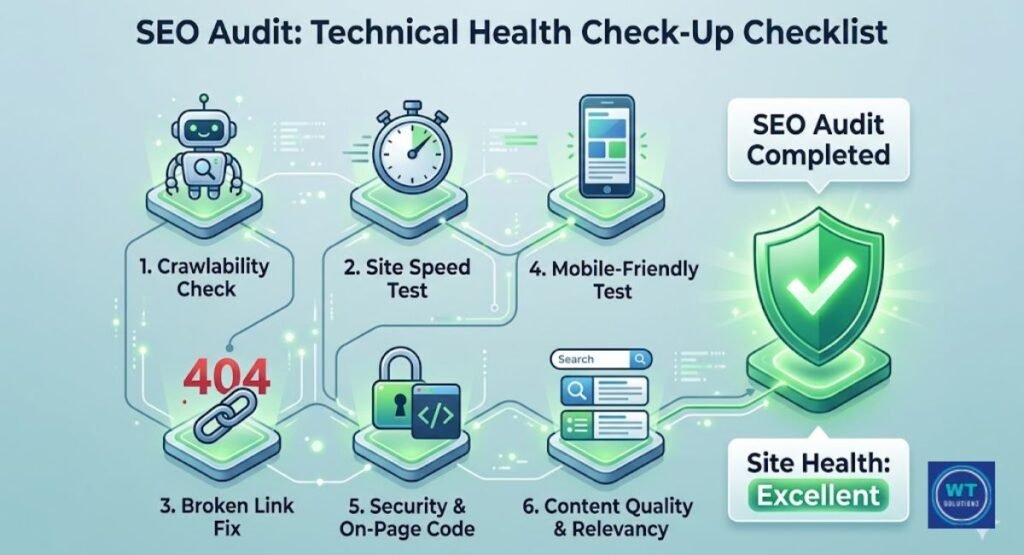
A thorough examination of your website is called an SEO audit. It examines everything that could be preventing Google from correctly understanding and ranking your pages, including your technical SEO infrastructure and on-page SEO components.
Imagine it as a mechanic checking your car’s engine before a lengthy road trip. Before you get on the freeway, you want to find out what’s wrong.
When a company launches a new website, follows a significant Google algorithm change, or experiences a sharp decline in traffic, the majority of firms conduct an SEO audit.
It’s a diagnostic tool that enables you to quickly identify underlying problems. Once you understand what’s wrong, you may address it and proceed with a well-defined plan.
Key Components Covered in an SEO Audit
An SEO audit considers more than simply one or two factors. It covers every part of your website, from top to bottom. Here’s a brief overview of what a thorough audit looks for:
| Audit Component | What It Checks |
| Crawlability and Indexability | Can Google find and read your pages? |
| Meta tags (Titles and Descriptions) | Are your titles and descriptions optimized? |
| Broken links (404 errors) | Are there dead pages hurting your UX? |
| XML Sitemap | Is your sitemap submitted and error-free? |
| Internal linking structure | Do your pages connect logically? |
| Site speed and performance | Does your site load fast enough? |
| Mobile responsiveness | Does your site work well on phones? |
| Duplicate content | Are there pages competing with each other? |
An excellent audit provides you with a site audit report full of useful information. It’s more than just a list of issues. It serves as a road map. You can see exactly what has to be fixed, why it’s important, and how it will affect your rankings after it’s finished.
What Is SEO Analysis? (The Performance Review)

Your monthly report card is an SEO study. It provides you with information about the real performance of your website in SERPs over time. You are examining data. patterns. trends.
It’s a strategic assessment of everything, including your backlink profile and the way users interact with your pages. It responds to the query, “Is our SEO actually working?”
SEO analysis never truly ends, in contrast to an audit. Because the web is always changing, you run it on a regular basis. Rivals advance. Google modifies its algorithm.
New terms emerge. Old ones deteriorate. This kind of ongoing monitoring leads to data-driven decisions, which is what distinguishes companies that expand naturally from those that remain on page three.
Main Focus of SEO Analysis
SEO analysis focuses on competitive positioning and performance metrics. What it usually covers is as follows:
| Analysis Area | What You’re Measuring |
| Keyword rankings | Where do your target pages rank on Google? |
| Organic traffic trends | Is your traffic growing, dropping, or flat? |
| Competitor benchmarking | How do you stack up against rivals? |
| Backlink profile | Are you gaining or losing quality links? |
| User Experience (UX) | Are visitors staying or bouncing fast? |
| Conversion rate optimization (CRO) | Are SEO visitors turning into customers? |
| User engagement metrics | Time on page, scroll depth, clicks |
The purpose of SEO analysis is to provide you with immediate tactical changes based on actual data. It’s a thorough analysis of the organic visibility of your website and how it changes over time. Not speculation. actual numbers.
The Main Difference Between SEO Analysis and SEO Audit:
These two are frequently confused. It’s simple to accomplish. However, they have rather different functions, and understanding the difference can save you a lot of hassles, money, and time.
To put it simply, an audit identifies issues while analysis monitors advancement. One represents a moment in time, while the other is a chronological narrative.
Which one do you truly require, then? To be honest? both. However, you use them for various purposes and at different times. Let’s dissect that in detail.
Scope and Depth
An SEO audit is extensive and comprehensive. It simultaneously examines all of your on-page SEO components, your site architecture, your website hierarchy, and your whole technological infrastructure.
It’s a thorough assessment that charts every fissure in your foundation. The impact of SEO factors over time, however, is the focus of an SEO analysis. It is more continuous but narrower.
| Feature | SEO Audit | SEO Analysis |
| Purpose | Find and fix problems | Track and improve performance |
| Frequency | Once or twice a year | Monthly or ongoing |
| Focus | Technical + on-page issues | Rankings, traffic, UX, backlinks |
| Output | Issues report + fix list | Trends report + growth insights |
| Best For | New sites, post-update recovery | Long-term strategy, growth planning |
Frequency (When to Do What?)
When you launch a new website, Google releases a major update, or your traffic suddenly declines, do an SEO audit. These are times when fundamental problems may have emerged, and you must quickly spot discrepancies.
Consider it your regular check-up for the health of your website’s SEO.
Conduct a monthly SEO analysis. Establish a timetable and follow it. Keep an eye on your competitor benchmarking data, monitor your organic traffic patterns, and check your keyword ranks.
This is how you continue to move toward long-term growth while making data-driven judgments. It’s not a choice. It’s simply the way that contemporary SEO operates.
A Deep Dive into Website Infrastructure Technical SEO Audit

Everything is built on your technical SEO infrastructure. It doesn’t matter how fantastic your content is or how many backlinks you have if it’s broken.
Pages that Google cannot effectively read, crawl, or comprehend will not be ranked. That is fixed by a technical audit. It delves deeply into the specifics of your website and identifies any problems that are impeding your rankings.
Ignoring technical SEO is akin to constructing a stunning home on a shaky foundation. From the outside, it appears fine. However, there’s always a problem behind the surface.
Even with good content, websites with inadequate technical infrastructure have lower organic visibility, higher bounce rates, and poorer SERP positions. First, fix the foundation. After that, everything else becomes simpler.
Crawlability and Indexability
Two of the most crucial technological aspects that Google considers are crawlability and indexability. Google’s bots can really access and read your sites if they are crawlable.
When a page is indexable, it can be added to Google’s index and displayed in search results. Your page won’t rank if either of them doesn’t work. It won’t even appear.
Here, your XML sitemap is crucial. It informs Google of the pages on your website and their connections. Google is told which pages to ignore by your robots.txt file.
When these are configured incorrectly, search engines may not be able to see parts of your website. A technical audit identifies these issues and provides you with precise solutions to address them before they result in increased traffic costs.
Site Speed and Performance
Performance and site speed are more important than ever. When Google introduced Core Web Vitals as a ranking criterion, it formally acknowledged that.
These metrics track how quickly people can really interact with your page, how quickly it loads, and how stable the layout is. Users are irritated by slow websites. And your user engagement stats show Google how frustrated you are.
Mobile responsiveness is equally important. By 2026, mobile devices will account for more than 65% to 70% of global search traffic.
Because Google uses mobile-first indexing, it takes your content’s mobile version into account for ranking and indexing.
If your website isn’t mobile-friendly, you are most likely losing out on more than half of your potential organic visibility.
Adjust your speed. Boost your mobile experience. The needle can be swiftly moved by these two factors alone.
Key Steps of an Effective SEO Analysis
An effective SEO analysis adheres to a precise, repeatable methodology. You don’t simply launch Google Analytics and look at data.
You follow certain procedures, evaluate data over time, and extract the insights that truly influence your approach. This is a straightforward procedure that you may use each month to do a thorough strategic assessment of your website.
Establish your baseline first. Before you do anything else, be aware of your traffic figures, your top-performing pages, and your current keyword ranks.
Next, contrast this month with the previous one. Keep an eye out for flat lines, drops, and spikes. You can learn something from every shift in the data. It is your responsibility to determine what. That is the foundation of data-driven SEO decisions.
- Establish your baseline metrics (conversions, traffic, and rankings).
- Monitor changes in keyword rankings every week.
- Examine your best and worst-performing content.
- To identify gaps, do competitor benchmarking.
- Examine your backlink profile for both lost and new links.
- Examine user engagement metrics such as time on page and bounce rate.
- Adapt your approach in light of the evidence.
Backlink Profile and Authority Assessment
One of the most powerful indicators Google uses to gauge the authority of your website is your backlink profile. Your rankings are raised by quality backlinks from reputable, pertinent websites.
Links that are spammy or toxic pull them down. A thorough SEO audit examines your backlinks on a regular basis to ensure that they are beneficial rather than detrimental.
Backlink benchmarking against competitors is particularly helpful. Examine the people who are linking to your main rivals but not to you. That’s your list of opportunities.
The likelihood that a website will connect to your material is much higher if it already links to related information. Although it takes time, developing a solid, clean backlink profile is one of the most important things you can do for your long-term organic search growth.
Content Effectiveness and User Experience (UX)
What attracts visitors to your website is its content. However, what keeps them around is User Experience (UX). Google recognizes if your content responds to a visitor’s query and if your page is simple to read and navigate.
It observes more pages visited per session, longer time on page, and reduced bounce rates. Better rankings are supported by all of these good user engagement measures.
A significant component of content efficacy is search intent matching. When a person clicks on any page on your website, it should be evident what they were looking for.
People will quickly leave your page if they search for “how to fix broken links” and it just discusses link building in general. Over time, this discrepancy damages both your rankings and conversion rate optimization (CRO). Prioritize writing for the user.
Naturally, rankings follow.
Essential Tools for SEO Audit and Analysis
For this work to be done correctly, you need the appropriate tools. Fortunately, some of the better ones are either extremely inexpensive or free.
You can save hours each month and work with more precise and relevant data if you know which tool to utilize for what task.
The secret is to avoid using all of the tools at once. Select one or two for continuing analysis and one or two for auditing. Learn how to do those. Obtain reliable data from them.
And use that information to improve the SEO health of your website every month.
Top Audit Tools
| Tool | Best For | Cost |
| Google Search Console | Crawl errors, indexing, and site audit reports | Free |
| Screaming Frog | Full technical crawl and on-page SEO elements | Free/Paid |
| Ahrefs Site Audit | Deep technical SEO infrastructure scan | Paid |
| SEMrush Site Audit | All-in-one diagnostic tool | Paid |
| Sitebulb | Visual site audit reports | Paid |
Top Analysis Tools
| Tool | Best For | Cost |
| Google Analytics 4 | Organic traffic trends and user engagement metrics | Free |
| Ahrefs | Keyword rankings and backlink profile tracking | Paid |
| SEMrush | Full strategic evaluation suite | Paid |
| Moz Pro | Authority tracking and competitor benchmarking | Paid |
| Ubersuggest | Budget-friendly keyword rankings and analysis | Free/Paid |
Why Does Your Business Need Both for Long-Term Growth?
You cannot measure what you haven’t corrected, nor can you grow what you haven’t measured. This is the main reason your company requires both a regular SEO analysis and an SEO audit.
If you just do an audit, you will have a list of fixes, but you won’t be able to determine whether or not those fixes were successful. You’re measuring a broken site and wondering why the numbers won’t change if you only run analysis and never audit.
Consider a practical case. Over the course of three months, a mid-sized US e-commerce company saw a decline in organic traffic trends.
Hundreds of broken links (404 errors), missing meta tags (titles and descriptions), and a failing Core Web Vitals score on mobile devices were discovered during a thorough SEO audit.
Everything was fixed. After that, they conducted monthly SEO analyses for six months. The amount of traffic doubled. There was a 34% improvement in conversion rate optimization (CRO). When you use both tools correctly, that’s what happens.
“Driving without a dashboard is similar to SEO without audits. Without analysis, SEO is like fixing your automobile but never giving it a test drive. Every business owner should remember this straightforward fact.
Only when you regularly monitor SEO factors over time will their effects become evident. An audit’s fundamental problems won’t go away on their own.
Additionally, if the technical base continues to crumble, tactical changes made during analysis will not be sustained. They both cooperate. Neither is effective on its own. Regarding long-term growth in organic search, it is the reality.
Read Also:
Toxic Backlinks
How to Submit an XML Sitemap to GSC
How to Perform a Content Gap Analysis
How to Identify Conversion Killers Through an SEO Audit
Summary: Are You Ready to Fix Your SEO Issues?
In summary, an SEO study reveals your growth, whereas an SEO audit reveals your weaknesses. A snapshot is one. The other is a narrative. To compete on SERPs in 2025 and beyond, your website must have both.
Start using Google Search Console right now. It’s not costly. In one location, it displays crawl errors, indexing issues, and your current keyword rankings.
This month, conduct your first SEO analysis to determine your current position. The data may surprise you. It’s not a terrible thing if you discover issues. That’s a chance. As you address each one individually, you’ll see an increase in your organic visibility.
Therefore, act now rather than waiting for traffic to slow down. Take the initiative. Make use of the appropriate tools. Observe SEO best practices. Make monthly judgments based on data.
And continue creating a website that your users and Google truly enjoy.