Your silo internal linking structure may be the true issue if your website isn’t ranking. not what you wrote. not the backlinks you have. Before ranking you, Google must comprehend the content of your website.
Additionally, Google quickly becomes confused when your pages lack a clear order. Low ranks are the result of a confused Google. It’s that easy. Your website is arranged into tidy topic groups using a solid silo structure SEO approach. Each group delves deeply into a single topic.
Each page cleverly links to related sites. This informs Google of your areas of expertise. And what sets page one winners apart in 2026 is thematic authority, which is developed through clever website architecture and well-organized content.
What Is Silo Structure SEO?
Consider your website to be a library. Cookbooks and science literature are not mixed in a reputable library. There is a section for everything. SEO in a silo system operates similarly.
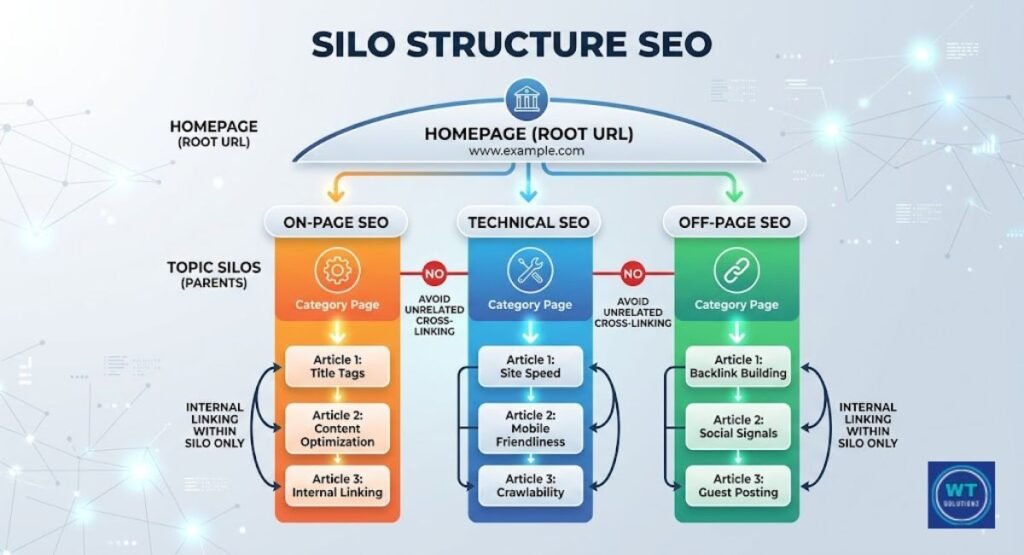
Your pages are grouped by subject. Every group, or silo, focuses on a single major topic. Within that silo, every page is connected to every other page. Nothing spills over into irrelevant subjects.
There are two primary components to a silo. The pillar page comes first. That is the large, comprehensive page that addresses the primary subject. Secondly, you have supplementary material.
These are more condensed, narrowly focused pages that go deeply into subtopics. Google loves cleanliness, and the content organization keeps everything tidy. Your reader feels the same way.
Why Silo Structure SEO Matters for Rankings
Google’s search engine crawlers come to your website and attempt to learn more about it. Crawlers become disoriented if your pages are connected at random.
Understanding why internal links are important for SEO is the first step in fixing this, as it helps search engines discover your content.
When combined with a clear structure, you can even submit an XML sitemap to GSC more effectively to ensure every corner of your silo is indexed.
However, crawlers navigate your website more easily when it has a defined hierarchical structure. They pick up on your subjects quickly. And rankings result from that comprehension.
This is a fact. Strong topical authority sites rank higher and more quickly. According to a 2023 Ahrefs study, pages with strong internal linking architectures are crawled more frequently and indexed more quickly than those with weak linking.
It’s not a guess. That’s information. That authority is built from the ground up via your silo structure.
Physical Silos vs Virtual Silos: Which One Should You Use?
Your URL structure has a physical silo. Subfolders are used to display the hierarchy. For instance, yoursite.com/seo/on-page-seo/ informs Google that “on-page SEO” is contained within the larger “SEO” section.
This is powerful. It incorporates the architecture of your website directly into the URL. This is nearly always the best course of action for new websites.
Your URLs are not altered by a virtual silo. Rather, it connects relevant pages using smart linking and internal link audit rules. Instead of using folders, you use links to direct Google through your content.
For current websites that cannot afford to alter their URL structure, this is an excellent solution. Both approaches are effective. However, the best option will depend on the current state of your website.
| Feature | Physical Silo | Virtual Silo |
| URL structure | Folder-based | Flat |
| Best for | New websites | Existing websites |
| Setup difficulty | Moderate | Easy |
| SEO strength | Very strong | Strong |
| Restructuring needed | Yes | No |
| Crawl efficiency | Excellent | Good |
How to Build an SEO Silo Structure: Step by Step
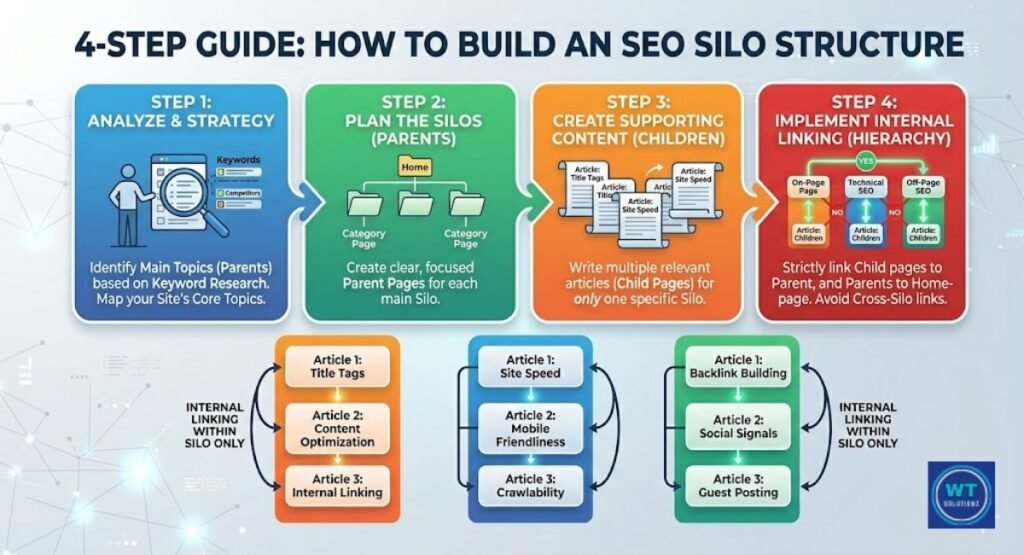
It’s easy to build a silo. However, you must have a strategy. It’s not enough to just link pages and hope for the best. Before you write a word, you should consider your site mapping.
Any site size, any budget, and any niche can use the steps listed below. Put them in the correct order.
Start by discussing your subjects. Next, construct your pages. Next, connect them appropriately. That’s the entire game.
However, the specifics are important. The following three sections provide you with a breakdown of it.
Identify Core Topics and Pillar Pages
The most crucial pages in your silo are your pillar pages. They all deal with a single major subject. For instance, a high-level pillar could be a guide explaining the difference between SEO analysis and an SEO audit, which serves as a foundation for more specific technical sub-topics.
One pillar page on your SEO blog, for instance, might be “On-Page SEO.” That pillar is the foundation of all on-page SEO. Meta tags, header structure, and keyword research. Everything.
Consider the true purpose of your website while choosing your primary subjects. What would you like to rank for? What matters most to your audience? Every response turns into a possible pillar.
Starting with three to five pillars is a good rule of thumb. Avoid attempting to cover everything at once. Before adding additional, make each silo sturdy.
Design the Website Architecture for Topic Clusters
You must construct your subject clusters after you have your pillars. Every cluster consists of a collection of pages supporting a single pillar. For an On-Page SEO silo, your architecture would include specific technical guides.
This includes clarifying the role of different tags, such as website title vs H1 tag, and explaining how meta descriptions impact SEO within those clusters.
Beneath it are the supporting pages. Every supporting page has a backlink to the pillar. Additionally, each supporting site is linked to the pillar.
Here’s what a simple cluster looks like:
Pillar Page: On-Page SEO
├── Supporting Post: Title Tag Optimization
├── Supporting Post: Meta Description Best Practices
├── Supporting Post: Header Tag Structure
└── Supporting Post: Image Alt Text Guide
└── All pages link back to Pillar Page
Google can easily crawl this content hubs and spokes model since it is clear and reasonable. Additionally, your readers won’t get lost when navigating it.
Implement Strategic Internal Linking (The LinkBoss Method)
The core of the LinkBoss approach is deliberate connectivity. Each link you post has a purpose. It either directs readers further into your silo or sends link juice up to your pillar.
You don’t make links at random. You connect with intent.
Here’s how the LinkBoss method works in practice:
| Link Direction | From | To | Purpose |
| Upward link | Supporting post | Pillar page | Pass link equity up |
| Downward link | Pillar page | Supporting post | Distribute authority down |
| Lateral link | Supporting post | Related supporting post | Connect related subtopics |
| No link | Any page | Unrelated silo | Keep silos clean |
LinkBoss and other automated internal linking solutions speed up this procedure. However, the rule is easy to follow even by hand.
Don’t leave your silo. Make a purposeful connection. Additionally, be sure that the anchor text you use describes the page you are connecting to.
Best Practices for Internal Linking in Silo Structure SEO
Include internal links in the content’s body. Not at the bottom. Not on the sidebar. Google gives more weight to body links.
Because they are situated within the real material, they are perceived as having greater significance. Here, too, anchor text optimization is important. Both Google and the reader should understand exactly what the linked page is about from your anchor text.
Don’t overuse links either. It is confusing to have thirty internal links on a page. Five to ten strategically placed internal links are ideal for the majority of sites. Prioritize quality over quantity.
Every link needs to feel organic. They should all enhance the reader’s experience. And they should all support your connection architecture objectives.
Use Relevant and Descriptive Anchor Text
The clickable words on a link are your anchor text. This specificity helps Google match your sites to the appropriate queries and also helps in defining the relationship between pages, especially when deciding between dofollow vs nofollow links to pass authority.
“Click here” provides no information to Google. However, “silo internal linking guide for 2026” provides Google with precise information about the content of the linked page. Google is able to match your sites to the appropriate search queries thanks to this specificity.
This is an example of anchor text variety in action. Change things up. Every time you link to the same page, use a new yet pertinent term.
Here’s a simple breakdown of good vs bad anchor text:
| Anchor Text Type | Example | Rating |
| Generic | Click here | Bad |
| Naked URL | yoursite.com/silo-seo | Bad |
| Descriptive | silo internal linking strategy | Good |
| Keyword-rich | 2026 silo SEO guide | Good |
| Over-optimized | silo linking silo SEO silo strategy | Bad |
| Branded | LinkBoss silo method | Good |
How Silo Structure Solves Keyword Cannibalization
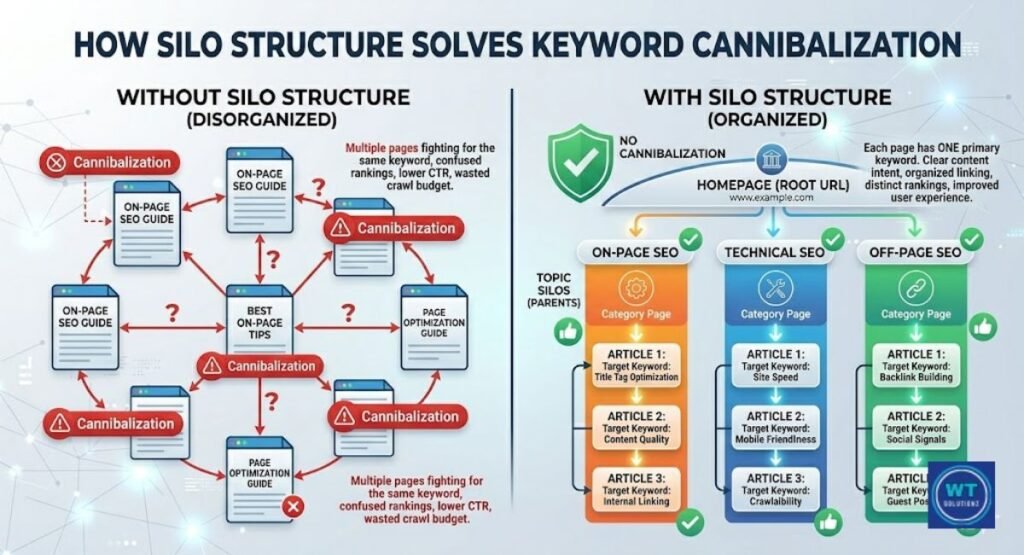
When two or more of your pages focus on the same term, it’s known as keyword cannibalization. On Google, they are competing with one another.
Google is unsure about which to rank. Thus, neither of them is ranked highly. This kills your traffic. The majority of site owners are unaware that they have this silent issue.
Silos quickly resolve this. There is no overlap when every page in your silo focuses on a distinct subtopic.
For example, by organizing your metadata strategy, you can avoid the common trap of duplicate meta descriptions that often cause two pages to compete for the same keyword.
The broad keyword belongs to your pillar page. The long-tail versions belong to your supporting posts.
Long-tail keywords are given separate pages. No two pages dispute the same phrase. When a website is tidy and well-organized, Google gives it higher rankings.
Common Mistakes That Break Your Silo Structure SEO
Cross-silo connecting is the most common error. Linking from one silo to an entirely separate silo occurs at that point. Google is confused about the purpose of your website.
Unless there is a really compelling reason to link out, keep your links inside their own silos. Even so, proceed with caution. You won’t be destroyed by a single incorrect link. However, a sloppy cross-linking habit will.
Making orphan pages is the second major error. There are no internal links connecting to these pages. Eventually, Google locates them. However, they have very little power.
Additionally, they frequently have no ranking at all. There should be at least one internal link linking to each page on your website. To identify these orphan pages before they cause you harm, conduct a routine internal link audit.
Here are the most common silo mistakes people make:
| Mistake | What It Does | How to Fix It |
| Cross-silo linking | Confuses Google’s topic signals | Keep links inside each silo |
| Orphan pages | Pages get no link equity | Add internal links to every page |
| Vague anchor text | Wastes link relevance signals | Use descriptive anchor text always |
| Too many links per page | Dilutes link value | Stick to 5-10 quality links per page |
| Deep crawl depth | Pages take too long to get indexed | Keep pages within 3 clicks of homepage |
| Mixed topics in one silo | Breaks topical authority | One topic per silo, always |
Tools to Build and Audit Your Silo Structure
You don’t have to build your silo construction by hand. Excellent tools that expedite and enhance the process are available in 2026.
Before using them, it’s wise to perform a content gap analysis to identify which sub-topics are missing from your current silo structure.
Crawl budget optimization is handled automatically by these systems. They point out weaknesses in your semantic silo builder configuration and show you how to fix them.
Here are the best tools available right now:
| Tool | What It Does | Best For |
| LinkBoss | Automates internal silo linking | Large sites needing fast linking |
| Screaming Frog | Crawls and maps your full site | Finding orphan pages and crawl issues |
| Ahrefs | Tracks link equity and rankings | Measuring silo performance |
| SurferSEO | Optimizes pillar page content | Content structure and NLP scoring |
| Google Search Console | Monitors index and crawl data | Free, real-time site health data |
| Sitebulb | Visual site architecture maps | Understanding your site’s structure |
Each tool has a specific strength. Use Screaming Frog to find orphan pages. Use Ahrefs to monitor the flow of link equity throughout your silos.
Use LinkBoss to automate the internal linking process. Additionally, utilize Google Search Console to keep an eye on how Google is scanning your website after you make changes.
Measuring the Success of Your Silo Structure SEO
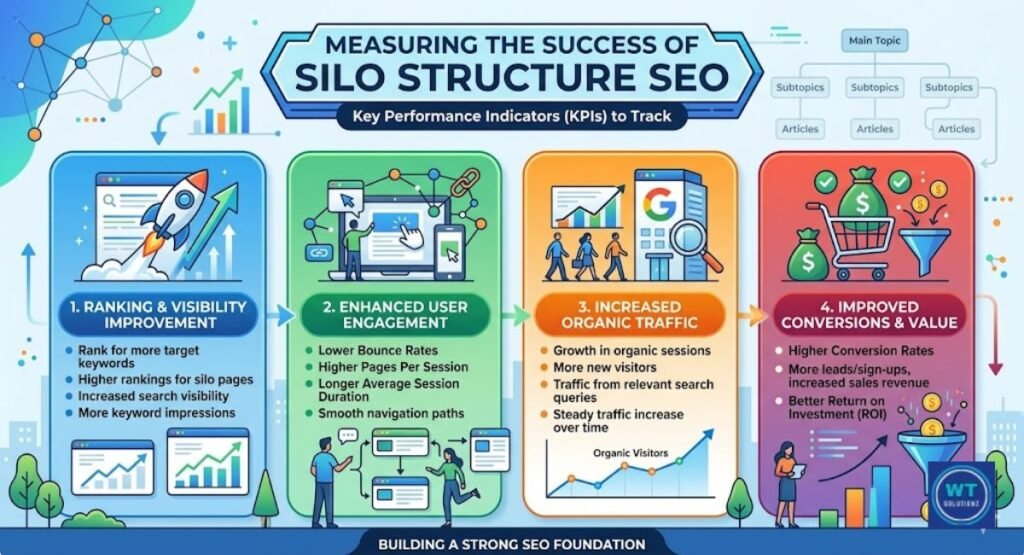
You built your silos. Now you have to find out if they are working. Keep an eye on your organic traffic increase by silo. Look at more than just your website’s total traffic.
Split it up into a topic group. If your SEO silo is growing but your social media silo is flat, you know where to go next.
Rankings are subject to change. However, don’t anticipate results right away. In 60 to 90 days, the majority of SEOs witness significant ranking gains via silo restructuring.
Certain competitive niches require more time. Have patience. And monitor these particular figures each month:
| Which silos does Google love most | What It Tells You | Tool to Use |
| Organic traffic per silo | Which silos Google loves most | Google Analytics |
| Keyword ranking positions | Are target pages climbing? | Ahrefs or SEMrush |
| Crawl depth per page | Are pages easy for Google to reach? | Screaming Frog |
| Internal link clicks | Are readers following your links? | Google Analytics |
| Pages indexed | Is Google finding all your pages? | Google Search Console |
| Bounce rate by cluster | Are readers finding what they need? | Google Analytics |
Case Study: How Silo Linking Boosted a USA Tech Blog by 214%
For more than a year, a mid-sized technology blog in the United States was stuck at 8,000 monthly visitors. Despite having 180 published pieces, they lacked a true framework.
Random links were made between pages. Subjects overlapped. Additionally, their ranks on many key terms were being destroyed by keyword cannibalization.
Their entire website was reorganized into five distinct silos. Cloud computing, device manuals, software reviews, cybersecurity, and tech news. Each article was allocated to a single silo.
Internal links were added to orphan pages. For every silo, new or improved pillar pages were made. No page was more than three clicks away from the homepage thanks to a reduction in crawl depth.
“In roughly eight weeks, we experienced our first significant increase in traffic. We reached 25,000 monthly visitors by the fourth month. For us, silo connecting was revolutionary. Austin, Texas, tech blog editor
Over the course of six months, organic traffic increased by 214% as a result. For a highly competitive term, their top pillar page moved from position 14 to position 3.
Additionally, their Ahrefs topical authority score increased in each of the five silos.
FAQs
What is the difference between a content silo and a topic cluster?
The framework that organizes linked pages on your website is called a content silo. The content strategy that chooses which pages to develop around a single major topic is called a topic cluster. They collaborate but have distinct functions.
How many internal links should be in a silo structure?
Five to ten internal connections are ideal for most pages. The pillar page should link to all supporting pages, and each supporting post should link back to its pillar page. Here, quality always triumphs over quantity.
Can I restructure an existing site into silos without losing rankings?
It’s safe to do so without losing your ranks. If you modify any URLs, use 301 redirects to ensure that your link equity is transferred. While restructuring your website, work in phases and keep a tight eye on Google Search Console.
Final Thoughts
In the end, silo internal connectivity will not be a possibility in 2026. It is the cornerstone of a ranking website. Google has become more intelligent.
It honors websites that clearly demonstrate subject-matter competence. And clever structure optimization and clear semantic interlinking between your pages are the only ways to demonstrate that skill.
If necessary, start small. Select one main subject. Construct a pillar page. Compose five posts that provide evidence. Use quality anchor text to connect them all.
For your next topic, follow the same procedure. You’ll soon have a website that Google respects. Additionally, a website that ranks is one that Google trusts.
Don’t wait, then. This is already being done by your rivals. Now is the time to build your silos and begin climbing.