Every owner of a website has encountered this issue. A 404 error page appears when you click on a link. Isn’t that frustrating? Now picture your guests experiencing that daily.
Without your knowledge, dead outbound links negatively impact your website’s reputation and search engine rankings. While fixing external issues is a priority, understanding how your overall internal links pass authority is just as vital for a healthy SEO profile. Here’s the good news, though. You may take advantage of every broken link on the internet.
When you properly fix external broken links, you can transform that issue into strong, superior backlinks that increase your authority. You can accomplish that by using a clever link acquisition strategy, as this guide explains.
What Is Broken Link Building and How Does It Work?
As part of the link acquisition method known as “broken link building,” you locate broken links on other websites, make a better replacement page, and then get in touch with the webmaster to propose replacing the broken URL with your functional one.
It sounds easy. It’s easy. However, the majority of individuals avoid it because they believe it takes too long. It doesn’t. Both users and search engine bots are informed that a website is no longer available by a 404 error page.
Visitors to a website encounter an obstacle when they click on a link to a dead page. They can have that wall fixed by you.
Here are the three simple phases that make up the process. On someone’s website, you first come across a page that points to a dead URL. Second, you produce a superior piece of content that addresses the same subject.
Third, you offer your page as a substitute and politely inform the webmaster that their URL structure is faulty. That’s all. No deception. No deception. Just value-first link building that is advantageous to all parties.
How Broken Link Building Works (Simple Flow)
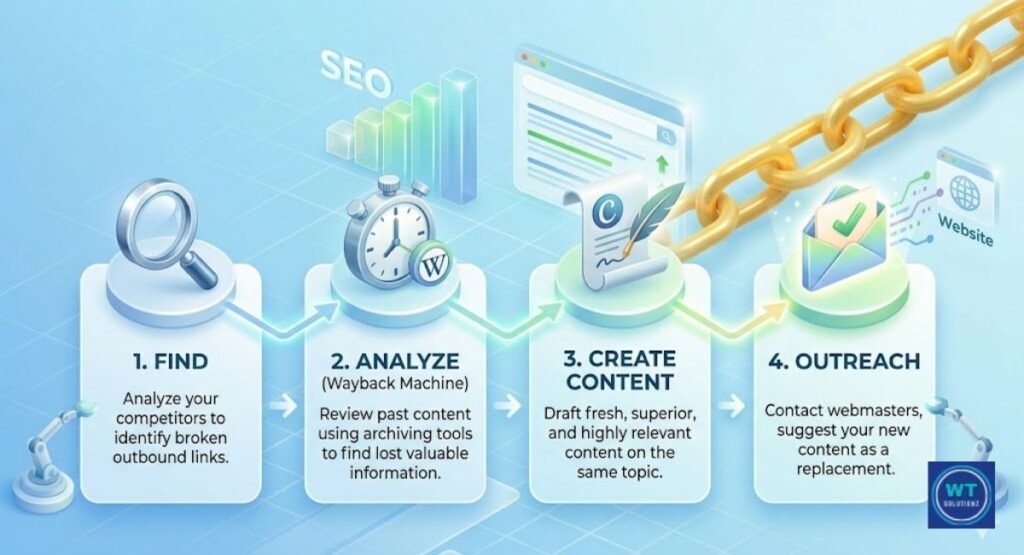
| Step | Action | Goal |
| 1 | Find a dead outbound link on a relevant site | Identify the opportunity |
| 2 | Use Wayback Machine to see the original content | Understand what to replace |
| 3 | Create better replacement content | Give the webmaster a reason to say yes |
| 4 | Send a personalized outreach email | Earn the backlink |
Why is Broken Link Building such an Effective Tactic?
The majority of link-building strategies resemble cold marketing. For no apparent reason, you reach out to strangers and ask them to connect with you. That is reversed by broken link building.
You lead with sincere assistance. You inform the webmaster that there is an issue with their website. That fosters trust right away. According to Ahrefs research, outreach emails aimed at establishing broken backlinks get much greater response rates than generic link requests.
Why? Because before you even ask, you’re resolving a genuine issue.
This is effective for another reason. There is link degradation. Every year, millions of pages are lost from the internet.
Every defunct page that has backlinks pointing to it presents you with a new opportunity. This strategy also scales quite well. You can discover dozens of broken link possibilities per week once you have a strategy in place.
Because the backlinks you receive are contextually appropriate backlinks from websites that already discuss your topic, it promotes sustainable organic growth. Google adores that. It will be reflected in your search engine rankings.
How Do You Find Broken Link Opportunities?
It’s not as hard as most people think to find broken link possibilities. It is not necessary for you to manually browse the web. You quickly expose dead links by using clever tools and tried-and-true techniques.
The three most effective approaches are as follows. Each one focuses on a distinct source of broken links. You’ll never run out of prospects if you combine all three.
Method 1: Competitor Dead Page Analysis
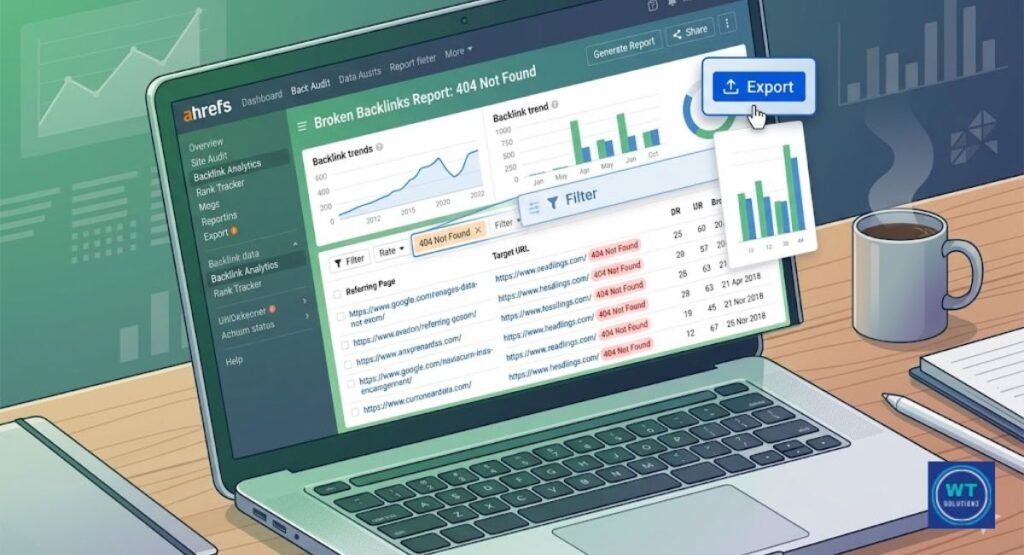
Examine your rivals first. Examine their backlink profile by pulling up their domain in Ahrefs and Semrush. Look for pages that return a 410 status or a 404 error page. Other websites continue to connect to those dead pages.
It’s pure gold. Link equity is already being sent to a page that is no longer in existence by real, active websites. It is your responsibility to fill that void and produce something better.
Here’s a quick step-by-step for this method:
- Launch Ahrefs Site Explorer and type in the domain of a rival.
- Select “Best by Links” and set the criteria to “404 not found.”
- The list of defunct pages with the highest number of referring domains can be exported.
- To see the original content, use the Wayback Machine at web.archive.org.
- Take note of each dead page’s subject, structure, and depth.
To ensure your new page actually outperforms the old one, you should perform a professional content gap analysis to identify what the original creator missed. Construct your own material around that particular subject.
Because you’re not speculating, this approach is effective. People’s desire for this information has already been demonstrated by the market.
They made a single link to it. If your version is good enough, they will also link to it.
Expert Advice: Pay attention to dead pages that have five or more referring domains. These are the most valuable goals, and they merit your entire content production effort.
Method 2: Target Site Crawling
This approach concentrates on one webpage at a time. You instruct a Screaming Frog crawl to examine all outgoing external links on a target website. Every page will be crawled by Screaming Frog, and any link that produces an error code will be flagged.
This provides you with a list of outbound links that are no longer active inside that website. Then you offer a solution. It’s straightforward. It is specifically targeted. And it’s effective.
Internal versus external connectivity is crucial in this situation. Screaming Frog can identify both types, but for this strategy, you should focus on the exterior ones. These are links that divert visitors from the website.
If the destination page is not accessible, the webmaster worries about the user experience. The solution is you. Export every 404, select the “External” tab, and set Screaming Frog to crawl mode.
Method 3: Resource Page Prospecting
Resource pages are carefully chosen collections of helpful links about a particular topic. Bloggers and instructors are always producing them. Additionally, a lot of those links eventually expire. That’s your opportunity. Use Google search operators to find these pages easily.
Use intitle: resources “your keyword” or “useful links” + your specialty. Webmasters are actively fixing many of the broken links on these pages.
Resource page link development works very well since the webmaster already values curation. They want their page to be useful.
Therefore, when you let them know that a link is broken and offer a better one, they are usually happy to update it. The best type of natural link acquisition is this one. You’re not forcing anything. They already care about it, and you blend in well.
Google Search Functions That Are Beneficial for Finding Resource Pages
| inurl:links “your keyword.” | What It Finds |
| intitle:resources “your keyword.” | Niche resource pages |
| inurl:links “your keyword” | Curated link pages |
| “useful links” + your niche | Topic-specific link directories |
| “recommended resources” + topic | Expert recommendation pages |
| “further reading” + your keyword | Blog-style resource sections |
5 Tools To Help You Identify Broken Links on Your Website
It is not necessary to discover broken links by hand. The right tools do the tough lifting for you. Each of the following serves a specific purpose.
For manual link audit tasks, some function better. Others are great for full-scale crawl efficiency. Select the option that best fits your budget and workflow.
1. Ahrefs Site Explorer is the industry standard for backlink research. It shows all of the pages on a domain that are no longer active, as well as the number of websites that continue to link to them. This is the best tool for backlink profile analysis in large-scale competition.
2. The Screaming Frog SEO Spider finds any broken external connections by scanning your entire website. It is fast, comprehensive, and gives you HTTP status codes for every URL it scans, including side-by-side HTTP status codes (404 and 410).
3. Google Search Console is free to use. It shows crawl problems and broken pages that Google’s search engine crawlers have already detected. It’s an excellent place to start, although it’s not as thorough as commercial tools.
4. SEMrush Site Audit creates a thorough website health score report by examining each broken link issue on your website. It will be ideal for teams seeking an all-inclusive SEO dashboard.
5. Dead Link Checker at deadlinkchecker.com is the simplest option. When you paste your URL, it promptly detects dead links. Perfect for beginners seeking a quick inspection.
Tool Comparison Table
| Tool | Free or Paid | Best Use Case |
| Ahrefs | Paid | Competitor & backlink analysis |
| Screaming Frog | Free / Paid | Full site crawl for broken links |
| Google Search Console | Free | Basic crawl error detection |
| SEMrush | Paid | Full SEO audit and site health |
| Dead Link Checker | Free | Quick single-URL broken link check |
How Do You Create Replacement Content That Gets Accepted?

The first step is to identify the broken link. The webmaster must genuinely come to trust your replacement content. You will always be disregarded if you send a flimsy, poor-quality replacement page.
The original content must be matched and then expanded upon. You get the link in this way. This is also how you gradually raise your website’s health score.
Next, produce something that is more designed, more contemporary, and more practical. If you aren’t sure where your current content stands, running a comprehensive SEO audit can help you evaluate your site’s health and quality signals before you start pitching to webmasters.
Your content’s E-E-A-T signals, Expertise, Experience, Authoritativeness, and Trustworthiness, have a significant impact on whether webmasters accept or reject you.
Matching the Original Content
Enter the broken URL at web.archive.org. You can view archived snapshots of the page’s previous appearance using the Wayback Machine. Examine it thoroughly. What was the structure? Was it a definition page, a list, a case study, or a how-to guide?
Make sure your replacement follows the same format. Write a better tutorial if the first one was in-depth. If the post were data-driven, collect new information and make it more robust.
It takes more than just matching length to create high-quality substitute material. It has to do with matching intent. There was a purpose behind the connection to that initial page. They believed their readers would benefit from it.
It is your responsibility to provide the same value in a better, more modern manner. Webmasters can tell when a replacement page is hurried. Take your time. Spend some time making it truly helpful.
Quality Signals That Increase Acceptance
Before making a decision, webmasters quickly review your material. They search for particular indicators of trust. a concise author profile with authentic qualifications. unique information, studies, or quotations they have never seen before. A simple, mobile-friendly design. A logical framework and appropriate headings.
Nothing on the page is thin, copied, or redundant. These are the E-E-A-T signals that indicate to a webmaster that the user is authentic. Linking to this resource is safe.
One thing is nearly always present on high-authority domain referral pages. They provide links to stuff that seems authoritative. It references sources. It demonstrates actual expertise. It doesn’t appear to have been composed in twenty minutes.
“Is this page genuinely better than what was there before?” is a question you should ask yourself before making a pitch. Send the pitch if the response is in the affirmative. If not, start by making the content better.
How Do You Write Broken Link Outreach Emails That Get Responses?
Outreach emails typically fail for one straightforward reason. Before giving, they inquire. The webmaster removes the writer’s “Hey, I have a great page, can you link to it?” without even reading it.
Effective outreach for link building starts with the issue, not the pitch. You start by informing them of their broken link. That makes you useful right away. You then subtly bring up your replacement. The formula is that.
Personalization of outreach emails is required. Your email is considered spam if it appears to have been copied and pasted. Make use of their name. Mention the page in question. Refer to the precise broken URL.
Demonstrate that you visited their website. This can triple your reply rate, but it takes an additional two minutes for every email. Emails for webmaster notifications that are personal and targeted are answered. Generic ones don’t.
Email Template Framework
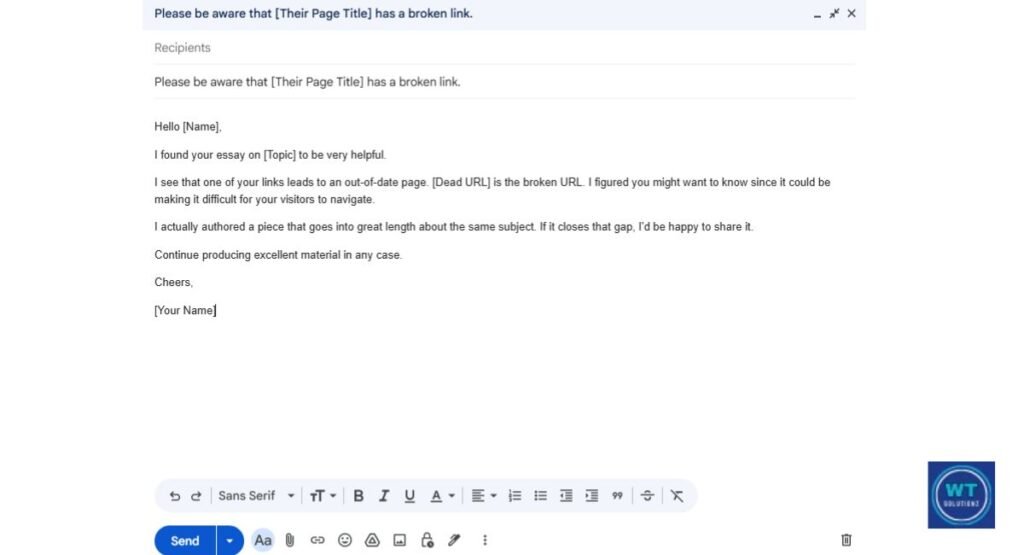
This is a simple, tried-and-true email structure that you may modify for any outreach effort, including broken links. Don’t go long. Keep it heated. Make it simple for them to accept.
Because it is based on value-first link creation, this template is effective. You are the first to give. Second, you ask. You also keep it light. Avoid attaching files. Avoid using more than one link.
Avoid writing three paragraphs about yourself. One useful observation. One gentle offer. That’s all. If you don’t hear back after five to seven days, follow up once. Proceed after that.
Common Pitfalls to Avoid in Broken Link Building
With this tactic, even skilled link builders make blunders. Targeting low-authority websites is the most popular method. You shouldn’t spend your attention on every backlink. To get the most SEO value, you need to understand the difference between dofollow vs nofollow links, as the former is what truly passes the link equity you need for higher rankings.
Choose carefully. Pay attention to websites that are genuinely authorities in your field. Every time, quality triumphs over quantity.
Sending careless, generic outreach is another major error. Your email will be disregarded by all 100 recipients if it appears to have been written for them all at once. Make each email unique. Make use of the webmaster’s name.
Mention the precise page they are on. Refer to the particular broken link. Never make more than two contact attempts. In addition to harming your reputation, aggressive follow-ups may cause your domain to be reported as spam. One first email. One follow-up. After that, you proceed.
Common Broken Link Building Mistakes to Avoid
| Mistake | Why It Hurts | What to Do Instead |
| Targeting low-authority sites | Wastes time for minimal SEO gain | Filter for DA 30+ or DR 30+ sites |
| Sending generic outreach emails | Gets ignored or marked as spam | Personalize every single email |
| Skipping the Wayback Machine check | Creates mismatched replacement content | Always check the original page first |
| Following up more than twice | Looks desperate and damages your brand | One follow-up max, then move on |
| Ignoring niche relevance | Off-topic backlinks confuse Google | Only target topically relevant pages |
| Not verifying the link is still broken | Embarrassing and wastes both your time | Double-check the URL before pitching |
| Skipping outreach tracking | Lose track of replies and opportunities | Use a simple spreadsheet to track all campaigns |
FAQs
What tools can I use to find broken external links?
Ahrefs, Screaming Frog, Google Search Console, SEMrush, and Dead Link Checker are the top broken link checkers. They all quickly identify dead outbound links. Start with the option that best suits your budget.
How do I approach website owners about a broken link?
Your webmaster notice email should be brief and cordial. Introduce the issue of the broken link first, then gently present your substitute page. It should never sound like a sales pitch.
Why do external links break if I did not change them?
Because the other website moved or removed a page, external links are broken. Third-party websites are completely out of your control. Every website eventually experiences this, which is known as link decay.
Is broken link building a white hat SEO strategy?
Indeed. It is completely safe and white hat. While gaining contextually relevant backlinks, you are addressing a serious issue for webmasters. This type of natural link acquisition is totally supported by Google.
Final Thoughts
In the end, you win on all fronts when you repair external broken connections to create high-quality backlinks. You support webmasters.
You receive pertinent links. You raise your rankings. Additionally, you create a genuine, repeatable system that continues to function month after month.
When combined with a solid silo internal linking structure, these high-quality external backlinks will turn your domain into a topical authority in no time.