Digital marketing for small businesses is essential because it eliminates massive advertising budget barriers, allowing local storefronts to target high-intent buyers, lower customer acquisition costs, and compete directly with global corporations.
This explains why digital marketing is important for small businesses, as establishing a robust online presence is the most cost-effective way to attract new customers and build local authority. Based on our hands-on client campaigns at our digital agency, TimeSolutionZ, leveraging data-driven internet marketing allows you to meet local buyers on mobile devices at the exact moment they search.
Replacing expensive traditional flyers with targeted digital advertising tactics significantly lowers overhead. Implementing this structured inbound marketing system ensures a predictable stream of web traffic, driving sustainable, long-term revenue growth for your storefront.
What Is Digital Marketing?
Digital marketing is the strategic practice of promoting products, services, or brands using electronic devices, mobile channels, and the internet. It encompasses all data-driven online marketing efforts aimed at connecting with current and prospective clients.
Unlike traditional advertising like billboards, radio ads, or printed flyers, this method uses internet channels to deliver messages. These channels include search engines, social networks, email, websites, and mobile applications.
It allows businesses to share information, track how people interact with ads, and talk directly with customers anywhere in the world. When you explore what is digital marketing, you find a complete system that connects your small storefront to thousands of local users who use search engines every single minute.
This modern promotional system creates a continuous loop of real-time data that traditional tools cannot match. When you launch an online campaign, you receive immediate feedback on exactly what your target audience likes to read. This differs completely from static traditional print ads because a newspaper layout cannot change after printing.
If an online advertisement fails to perform well, you can edit the phrasing within seconds to improve your metrics. This flexible structure ensures that you never waste your budget on promotional materials that do not work.
Why Is Digital Marketing Important for Small Businesses?
Digital marketing is important for small businesses because it shifts the playing field from massive media budgets to highly targeted, measurable, and hyper-local online discovery.
It replaces expensive traditional channels with affordable tactics that target users based on real-world behavior and search intent. In our digital agency, TimeSolutionZ, we observed that companies using modern digital paths lower their customer acquisition costs by up to 60% while simultaneously scaling their local visibility.
Recent data shows that companies spend over 54% of their marketing budgets on digital ads because that is where customers look first.
When you look at the 10 benefits of digital marketing, you see a clear path to business growth:
- Reach a Larger Audience
- Cost-effective
- Increased ROI
- Increased Brand Awareness
- Greater Flexibility
- Be Visible 24×7
- Run Multiple Strategies At Once?
- Various Content Forms to Play With?
- Higher Content Engagement
- Measurable Results
Here are the primary ways online promotion helps your small business succeed:
Increases Online Visibility
Most consumers start their buying journey by searching online. If your company does not appear in search results, potential clients will choose your competitors. Having a website and social profiles makes your business visible to thousands of people who are already looking for what you sell.
For example, if you run a local pet shop and someone searches for organic dog food, a well-optimized website puts your store address right in front of their eyes.
Builds Trust And Brand Authority
When people see your helpful articles, positive online reviews, and active social media pages, they feel safe buying from you. Sharing useful details shows that you understand your industry. Many new business owners wonder: is digital marketing legit for small operations?
The answer is a clear yes. Showing your real work, answering customer questions publicly, and sharing video testimonials proves your business is completely real, safe, and professional. It is completely legit because it relies on real customer reviews, transparent case studies, and building direct customer trust instead of vanity metrics like fake numbers or superficial likes.
This builds a strong reputation and proves you are a reliable, trustworthy business partner.
Targets Your Ideal Customers
Traditional ads display your message to everyone, even people who have zero interest in your shop. Online promotion lets you select exactly who sees your ads based on age, location, interests, and habits.
You save money by only showing your ads to people who are likely to buy. For instance, a wedding cake baker can choose to display video ads only to local people who changed their relationship status to engaged within the last month.
Delivers Measurable ROI
With print ads, it is hard to tell how many people saw your flyer or bought an item because of it. Online platforms provide clear numbers. You can see exactly how many people clicked your ad, visited your website, or made a purchase, making it easy to see your exact return on investment.
The structural advantages of digital advertising show up in your daily data dashboards. When analyzing the Top 20 Advantages and Disadvantages of Digital Marketing, real-time profitability tracking always emerges as a major benefit. For instance, if you spend ten dollars on a targeted web ad and it brings in three customers who spend fifty dollars each, you know your promotional system is working perfectly.
Encourages Customer Interaction And Loyalty
The internet allows for two-way communication. Customers can comment on your posts, ask questions, and send direct messages. Answering these messages quickly shows you care about your dynamic audience.
This friendly interaction turns one-time shoppers into loyal, repeat customers. A simple reply to a comment on a photo or a quick thank you message creates a personal bond that giant national corporations can never duplicate.
Levels The Playing Field
In the past, massive corporations dominated the market because they had massive advertising budgets. Online platforms give small brands the same tools as giant companies.
A well-optimized local listing or an engaging social media video can outrank a billion-dollar brand and win local clients. Search engines prioritize local helpfulness and accurate information over corporate wealth, allowing your small shop to claim the top spot.
How Does Digital Marketing Help Small Businesses Grow Locally?
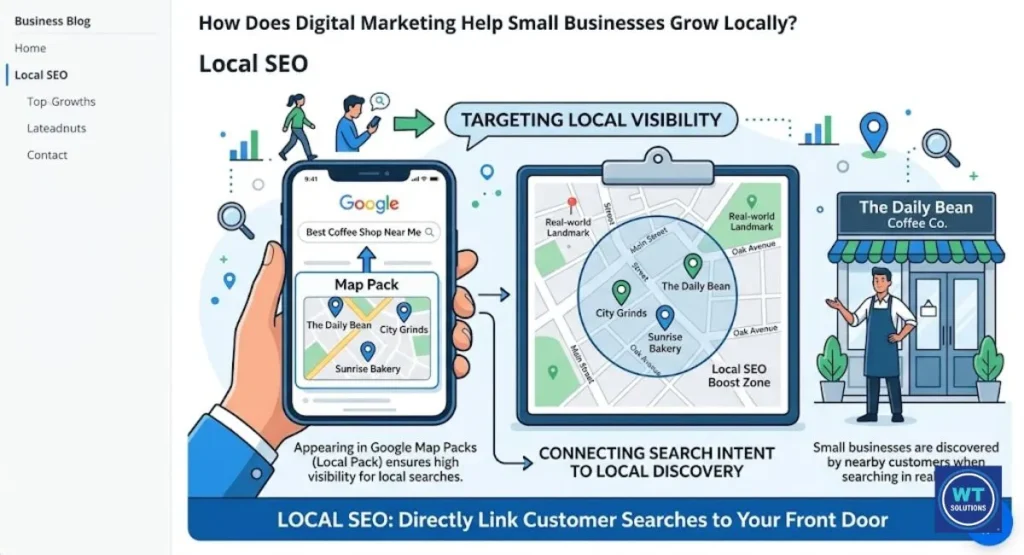
Digital marketing helps small businesses grow locally by capturing high-intent nearby buyers through local map optimization, location-specific search queries, and hyper-targeted geographical ads.
Our team at TimeSolutionZ found that optimizing a brand’s local footprint places its storefront directly into the map packs of local smartphone users. Because modern search engines prioritize proximity and verified local reputation, small operations can capture foot traffic faster than distant corporate giants.
Local SEO
Optimizing your website for local searches ensures your shop appears when neighbors search for terms like “plumber near me” or “best bakery in town.” By targeting location-specific phrases, your business surfaces right at the top of the search page when buyers are ready to make a purchase.
You can achieve this by adding your town name, zip codes, and neighborhood landmarks directly into your website text.
Online Reviews And Reputation Management
Modern buyers treat online reviews like personal recommendations from friends. Collecting positive ratings on public profiles makes your business look credible.
Replying nicely to both good and bad reviews proves that you run a legit business that values client satisfaction. When you handle a negative review with kindness and offer a clear fix, onlookers see that your customer service is excellent.
Geo-Targeted Advertising
Paid advertising platforms allow you to set strict geographical boundaries for your campaigns. You can choose to show ads only to people within a five-mile radius of your physical store. This feature keeps your budget safe by ignoring people who live too far away to visit you.
A local hair salon can target people living in specific nearby streets, ensuring every single ad dollar goes toward a potential local customer.
Community Engagement On Social Media
Social networks let you connect with local community groups, sponsor neighborhood events, and chat with residents. Sharing updates about local activities builds human-to-human connections.
This makes nearby residents want to support your local independent business over national chains. You can share photos of your team participating in town cleanups or high school sports sponsorships to build local pride.
Essential Digital Marketing Strategies for Small Businesses
A small business does not need to use every online platform to see great results. Instead, focusing on a few proven methods will generate steady leads and steady sales. Here are the core tactics that form a strong foundation for business growth:
| Strategy Name | Main Purpose | Expected Results |
| Search Engine Optimization | Get free, long-term traffic from search pages | Steady flow of inbound visitors |
| Social Media Marketing | Build a community and talk with customers | Higher brand awareness and engagement |
| Email Marketing | Nurture leads and drive repeat sales | Highest return on investment per dollar spent |
| Content Marketing | Answer customer questions with articles or videos | Stronger brand authority and customer trust |
Search Engine Optimization (SEO) and Inbound Marketing
This method focuses on improving your website so it ranks higher in organic search results. By adding relevant phrases to your pages, you attract organic traffic without paying for every single click.
This creates a sustainable inbound marketing system where buyers discover your business naturally while searching for answers.
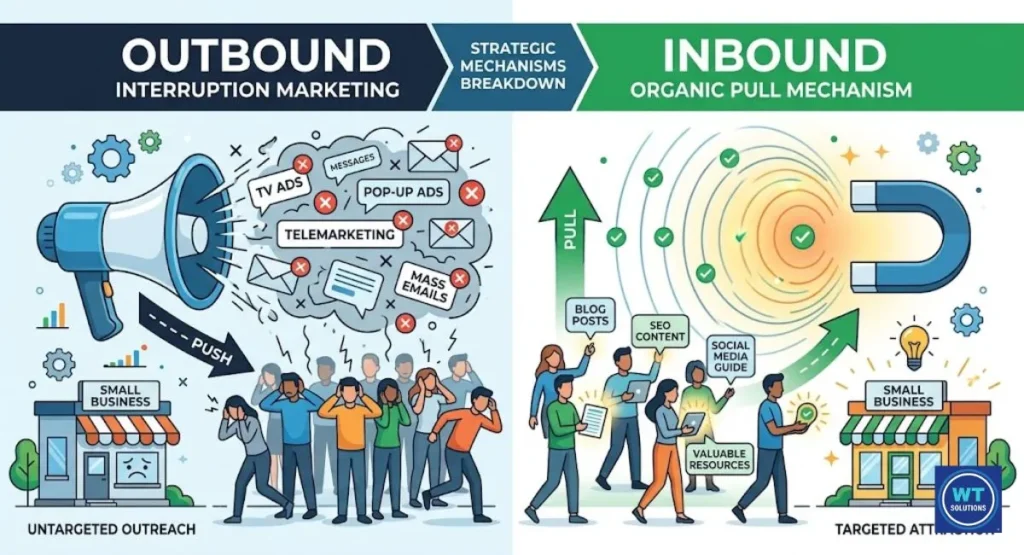
This highlights the powerful connection between SEO and Inbound Marketing. Traditional advertising uses outbound methods, which means you interrupt a user with a cold phone call or a loud commercial.
In contrast, inbound marketing acts as an organic customer pull mechanism that brings ready-to-buy users directly to a small storefront without intrusive sales pitches. When you optimize your web pages to solve specific consumer issues, customers look for your help voluntarily. This pull strategy ensures that you interact only with qualified leads who genuinely want to purchase your items immediately.
- Research local phrases that your customers type when they want to buy items.
- Place these phrases naturally inside your page titles, main paragraphs, and image descriptions.
- Keep your website clean, fast, and easy to read on every type of screen.
Social Media Marketing
This strategy involves sharing helpful posts, pictures, and short videos on platforms where your ideal clients hang out. It is a fantastic tool for displaying your brand personality and answering buyer questions. Regular posting keeps your company top-of-mind when followers need your products.
- Post helpful tips that solve common issues instead of just posting sales pitches.
- Respond to every single comment and question within twenty-four hours to build a community.
- Share behind-the-scenes videos to show the real people who build your products.
Email Marketing
Building an email list allows you to send direct updates, discounts, and helpful newsletters straight to an inbox. Email remains one of the most profitable channels for small brands. Studies confirm that email marketing returns an average of $36 for every $1 spent, making it an incredibly cheap way to boost revenue.
Gathering email addresses directly from real website visitors gives you a massive advantage because it relies entirely on first-party data. By collecting these records safely with customer permission, you build a highly secure, private business asset that does not depend on tracking cookies or changing tech laws.
You can reach your audience directly whenever you want without paying a third-party platform to display your updates.
- Offer a small discount or a free checklist to encourage website visitors to sign up.
- Send regular, helpful messages so your audience remembers your name.
- Keep your emails clean, easy to read, and short so users do not get bored.
Content Marketing Strategy
This process involves creating free, useful resources like helpful articles, guides, and videos that solve buyer problems. Instead of screaming “buy now,” you offer genuine value first. This strategy attracts interested buyers to your website and turns them into paying clients over time.
- Write detailed answers to the exact questions your customers ask during phone calls.
- Use simple language and clear bullet points so your guides are easy to understand.
- Update your older articles regularly with fresh details to keep them highly accurate.
Developing a Marketing Plan
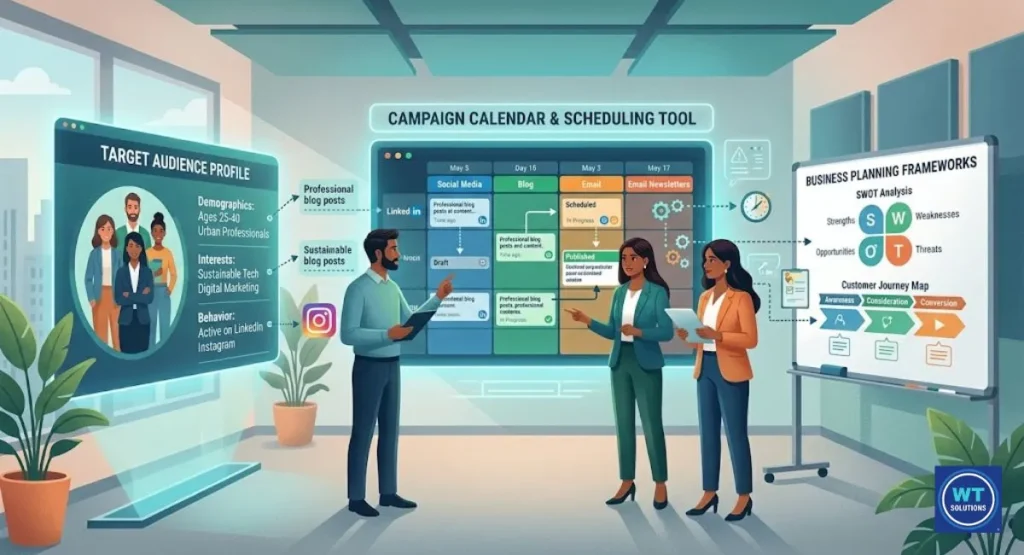
A successful online campaign requires a clear roadmap rather than random guesses. Building a proper marketing plan keeps your goals aligned with your daily business operations. You can build a complete framework by using 9 Marketing Strategies for Small Businesses to cover your bases.
These core strategies include local maps optimization, business blogging, social video sharing, email newsletters, community networking, targeted web ads, referral rewards, reviews collection, and helpful free workshops.
When building this blueprint, many owners ask: What is a marketing partner, and do I need one? A marketing partner is an external guide, professional agency, or specialist helper who manages your online campaigns so you can focus entirely on your physical business operations. If you have a small budget, you can act as your own partner by using free software.
First, define your target audience by listing their age, problems, and favorite online channels. To do this without confusion, write down a detailed description of your best existing customer.
Record their common hobbies, their daily frustration points, and where they look for advice online. This direct profile ensures that you do not waste resources sending messages to groups that will never buy your services.
Next, look at what your competitors are doing online to find gaps in their strategy that you can fill. Visit their active social media pages and look closely at their consumer reviews to see what local buyers complain about regularly.
If local clients state that a competitor takes too long to reply, you can highlight your fast response times in your own advertisements. This analysis helps you stand out in your local market immediately.
Set a clear budget, remembering that small businesses usually spend between 7% and 12% of their total revenue on marketing efforts. If you operate a completely new storefront, start small by focusing your funds on a basic website and local search tools.
You can increase this financial allocation gradually as your digital campaigns generate steady cash flow. Tracking every single dollar spent prevents unexpected financial strains on your operations.
Finally, create a content calendar so you can post text updates and videos consistently without rushing at the last minute. Sit down once a month to sketch out your upcoming topics, keeping them aligned with seasonal changes or local town events.
You can write your short educational paragraphs ahead of time and store them in a simple digital document. This careful planning prevents empty profiles and keeps your brand active online every single week.
How Digital Marketing Drives Revenue and Long-Term Growth
Digital marketing drives sustainable business revenue by building digital equity that compounds over time. Unlike traditional channels, where visibility ends when payment stops, a well-structured web infrastructure continuously draws in leads.
Based on our hands-on client campaigns at TimeSolutionZ, moving customers away from short-term outbound tactics and into organic inbound loops ensures that your average cost per lead drops steadily as your brand authority expands.
This results in a reliable flow of daily website visitors without an increase in your ad spend. Furthermore, digital channels allow you to create automated sales funnels. A customer can discover your blog post, join your email list, and buy your product automatically while you sleep.
This automated system scales your business revenue without demanding more manual labor hours. Over time, your reliance on paid media drops because your organic presence acts like a 24/7 digital salesperson for your brand.
This continuous growth happens because digital content functions as a compounding business asset. When you publish an educational article that solves a common neighborhood issue, that text piece gains authority every single month.
As more local neighbors click the link and read your answers, search engines push your website higher on the main results page. This long-term equity drops your average cost per lead significantly over time because you do not have to buy paid ads to capture interest.
Consequently, your historical web posts turn into consistent money-making assets that work for you around the clock. A simple maintenance guide that you published two years ago can easily attract ten new clients this week if it ranks at the very top of local search results.
Traditional billboards require a fresh rental check every single month, or the company tears down your message. Digital marketing allows you to build a permanent web foundation that generates reliable storefront income for years to come.
What Are the Most Common Digital Marketing Mistakes Small Businesses Make?
Small businesses commonly fail in digital marketing by running scattered campaigns without an overarching strategy, neglecting mobile optimization, and ignoring analytics data. In our digital agency, TimeSolutionZ, we observed that tracking vanity numbers like social media likes instead of true customer acquisitions wastes massive amounts of capital. Avoiding these errors keeps your digital assets profitable.
No Strategy or Content Plan
Posting randomly whenever you feel like it rarely works. Without a unified content plan, your messaging looks confusing and fails to guide visitors toward making a purchase. Every post should have a clear purpose, such as answering a specific customer question or showing off a new local service.
Ignoring Mobile Users
More than 60% of all online searches happen on mobile devices. If your website is slow, text is too small, or buttons are hard to click on a phone, visitors will leave immediately. A bad mobile layout destroys your sales because search engines drop slow mobile sites from their top rankings.
Neglecting Analytics
Running ads without looking at performance metrics is like driving with your eyes closed. You must check your data regularly to see which campaigns bring in money and which ones waste your budget. Focus on real numbers like contact form completions instead of simple likes on a photo.
Buying Fake Followers or Cheap Backlinks
Some services promise thousands of social followers or cheap links for a small fee. These are scams that use robotic spam accounts. Search engines and social platforms penalize profiles that use these bad tricks, which can ruin your online reputation permanently. Focus on real human connections instead.
Top 5 Digital Marketing Tips For Small Businesses
If you are feeling overwhelmed by all the online options, focus on these five basic steps to build momentum safely:
| Tip | Action Item | Free Tool to Use |
| Create or Improve Your Website | Build a simple, fast home page with clear contact details | WordPress or Google Sites |
| Claim Your Business Profile | Fill out your local map details, hours, and photos | Google Business Profile |
| Choose 1-2 Social Platforms | Publish helpful tips twice a week where your buyers hang out | Meta Business Suite |
| Start Collecting Emails Early | Place a simple subscriber form on your website home page | MailerLite or Mailchimp |
| Use Free Tools for Impact | Research what people look for and create clear graphics | AnswerThePublic and Canva |
What Are the Future Trends in Digital Marketing for Small Businesses?
The future of small business digital marketing hinges on adapting to conversational AI engines, video content, and cookieless user tracking. Staying ahead means preparing your website infrastructure to serve direct answers to search engines while building direct channels to your customer pool.
At TimeSolutionZ, we recommend preparing your online assets for a landscape that values data privacy and quick, visual micro-content.
Voice Search And AI Integration
Consumers now use voice assistants and conversational search tools to get direct answers instead of clicking through long lists of traditional web links. To rank well in this environment, write your content in a natural, conversational style that directly answers user questions.
Figure out the exact words people say out loud, like “Where is the closest bicycle repair shop open right now?”
Write a clear, single sentence answer directly underneath your headings so conversational tools can read it easily.
Use free tools like the Schema Markup Generator to add structured local data to your website code without any engineering skills. This structured data acts like a direct data sheet that helps modern search engines display your hours, prices, and address instantly.
Video-First Content
Short vertical videos continue to dominate consumer attention on social networks. Buyers love watching quick, behind-the-scenes clips, product demonstrations, and simple tip videos because they feel human and authentic.
You can use your mobile phone to film a sixty-second clip explaining how to maintain a backyard patio, upload it to video platforms, and attract local clients without spending a dime on video production crews.
Hyperlocal Marketing
Search platforms are getting better at pinpointing exact physical locations. This means campaigns can target specific neighborhoods or streets. This allows small local businesses to win buyers who are just a few steps away from their doors.
You can achieve this by creating separate website landing pages for individual neighborhoods that you serve.
Privacy-Conscious Advertising
Tighter global internet rules mean old tracking cookies are disappearing. Modern advertising relies heavily on first-party data. This means businesses must gather customer information directly through direct email signups and voluntary memberships rather than tracking cookies.
Building your own subscriber list protects your business from sudden changes in data tracking laws.
Measuring Digital Marketing Success
Measuring digital marketing success requires tracking key performance metrics that correlate directly to business revenue rather than superficial engagement signals. At TimeSolutionZ, our team prioritizes conversion value over simple impressions.
Monitoring conversion trends allows small operators to isolate their most profitable acquisition channels and safely double down on their highest-performing strategies.
Website Traffic
Monitor the total number of people visiting your site and see if your organic search traffic is growing monthly. This helps you understand if your free helpful articles are bringing in new eyes.
Conversion Rate
Track the exact percentage of visitors who take action, such as filling out a contact form or buying an item. A high visitor count means nothing if nobody contacts your sales desk.
Click-Through Rate (CTR)
This shows how many people click on your link after seeing it appear in search results or online ads. An interesting, clear title increases this percentage significantly.
Cost Per Acquisition
Calculate exactly how much advertising money it takes to gain one single new paying customer. Keep this number lower than the profit you make from a single sale.
Common Digital Marketing Challenges and Solutions
Owners face specific challenges with digital marketing when trying to balance field work with online content creation. Use this practical problem vs. solution matrix to overcome these hurdles smoothly:
| Challenge | Real World Solution |
| Not Enough Time | Spend two hours on Sunday afternoon using free tools like Meta Business Suite to schedule your weekly social posts automatically. |
| Small Marketing Budget | Skip paid ads and focus entirely on free options like your Google Business Profile and local search engine optimization. |
| Confusing Technology | Master one simple tool at a time. Watch free online video tutorials and ignore complex data screens that do not track real phone calls. |
FAQs
Why is digital marketing important for small businesses in 2026?
It is important because consumers use conversational tools and mobile maps to find everything they buy. Traditional ads have lost their effectiveness, making an active online presence mandatory for survival.
What is the most effective digital marketing strategy for a small business?
For long-term growth, search optimization combined with high-quality content marketing is best because it brings free traffic. For instant sales, email marketing provides the highest direct financial return.
How much should a small business spend on digital marketing?
Most healthy small businesses allocate between 7% and 12% of their total company revenue toward marketing, spending roughly half of that specific budget on digital channels.
Can small businesses do digital marketing without a big budget?
Yes. Creating a free local business profile, publishing helpful articles, and building an organic email list costs time rather than money and can attract plenty of local clients.
How does digital marketing help small businesses compete with large companies?
Online platforms grade content based on helpfulness and local relevance rather than budget size. A small shop with excellent reviews and great local optimization can easily outrank a massive corporation.
How long does it take for digital marketing to work for a small business?
Paid advertisements and social posts can generate leads within a few days. Organic search optimization and content marketing strategies typically take between three and six months to show significant results.
What digital marketing channels should a small business focus on first?
A small brand should start by optimizing its website for local search and setting up its free local map listing. Once those are working, add an email signup form and one primary social media page.
Conclusion
Digital marketing is no longer an optional luxury for small brands. It is a vital tool that allows you to find local buyers, build authority, and generate predictable business revenue. By focusing on simple, customer-first strategies like search optimization, helpful content, and local listings, you can compete with larger brands and win.
Start with small, consistent steps, track your results, and watch your small business grow over time.